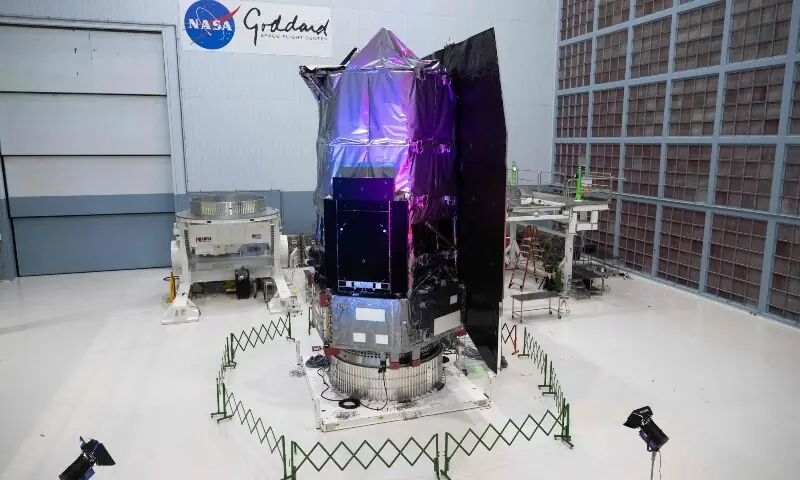
Nasa unveiled the Nancy Grace Roman Space Telescope, a >$4 billion observatory with a 12-meter mirror and a field of view at least 100 times larger than Hubble’s. The mission is designed to identify tens of thousands of exoplanets and study dark matter and dark energy, with launch planned for September at the earliest. While scientifically significant, the article is largely informational and is unlikely to have direct market impact.
This is a rare example of a government-led capex event that should matter more to the private space economy than to NASA itself. The first-order beneficiary is the launch and spacecraft manufacturing complex, but the bigger second-order effect is on the data-processing stack: a survey telescope that generates a data firehose should accelerate demand for downlink, ground-segment software, cloud compute, and AI-assisted cataloging. That makes the more durable trade not the launch itself, but the picks-and-shovels layer that monetizes every future space observatory through sustained analytics, storage, and mission operations.
The near-term risk is timing slippage, not demand destruction. A September launch window means the catalyst is front-loaded into the next 3-6 months, but the monetization curve for downstream beneficiaries extends 12-36 months as data products are published and follow-on observations are scheduled. Any launch delay would mostly defer the sentiment pop; a mission anomaly would hurt the broader space/launch tape, but even then the data infrastructure winners would likely be insulated because their revenue is tied to operational throughput across the sector, not a single mission.
The contrarian point is that the market may over-index on the glamour of the telescope and underprice the operational bottlenecks. The scarce asset is not a bigger mirror; it is the pipeline from sensor to scientific inference, which gets more valuable as sensor resolution improves. That argues for leaning into businesses with recurring government and commercial space contracts rather than pure-play launch names that already trade on event-driven optimism and face binary execution risk.
AI-powered research, real-time alerts, and portfolio analytics for institutional investors.
Request TrialOverall Sentiment
mildly positive
Sentiment Score
0.15
