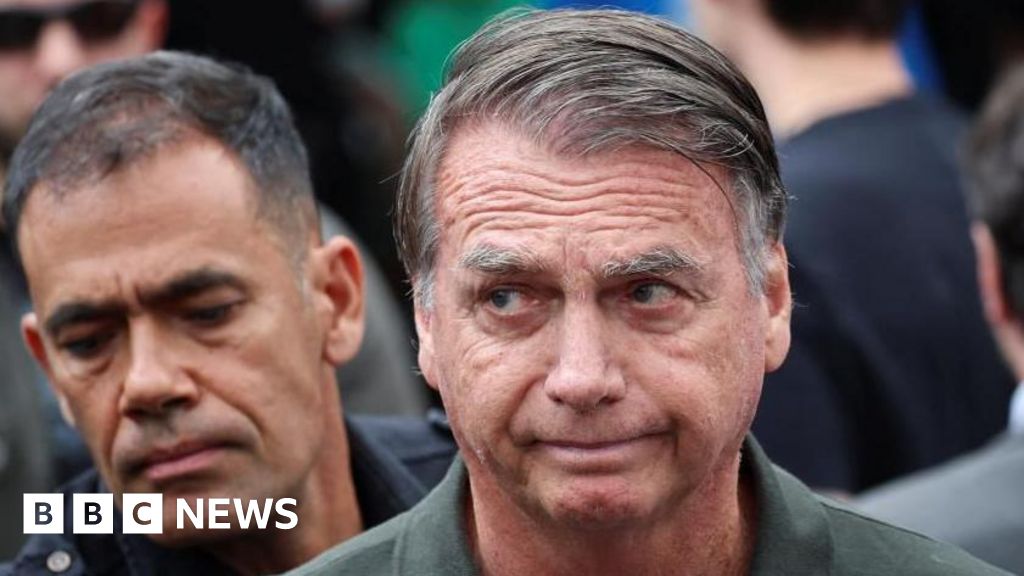
Jailed former Brazilian president Jair Bolsonaro underwent a successful double-hernia surgery in Brasília after the Supreme Court authorized a hospital transfer; he is serving a 27-year sentence for plotting a coup and is expected to return to federal custody once cleared. Bolsonaro publicly endorsed his eldest son, Senator Flávio Bolsonaro, for the 2026 presidential race via a handwritten letter, while Congress recently passed a bill to shorten his sentence that President Lula has pledged to veto — developments that sustain political uncertainty ahead of the 2026 election cycle.
Market structure: Bolsonaro's sustained influence and a formal endorsement of Flávio Bolsonaro raise the probability of a highly polarized 2026 Brazilian election cycle, increasing political risk premia for domestically-sensitive assets. Expect rotation away from domestic financials and consumer plays toward commodity exporters if markets price higher policy uncertainty; move magnitude plausible: 3–8% widening in local credit spreads and 2–6% BRL depreciation on pronounced risk-off moves within weeks.
Risk assessment: Tail risks include renewed street unrest or legislative changes that materially alter rule of law (5–10% probability) which would spike CDS and FX volatility; alternatively, a right-leaning policy pivot could be market-positive for privatization/energy names (10–25% probability by mid-2026). Immediate (days) risk is volatility spikes around surgery/releases; short-term (weeks–months) is campaign messaging and legislative tussles; long-term (quarters) is election outcome and policy continuity.
Trade implications: Tactical defensive hedges are warranted now — buy short-dated protection and favor real-asset exporters over domestic banks. If BRL moves >3% weaker in 7 days, accelerate hedges; if polling shows Flávio >30% six-to-12 months before election, rotate toward advantaged sectors (energy, miners).
Contrarian angles: Consensus may over-penalize commodity exporters; Vale (VALE) and Petrobras (PBR) have tangible cash flows and LNG/oil prices can offset political risk — under a run-off to the center-right these could rerate +15–25% into 2026. Conversely, domestic banks (ITUB, BBD) may already price much of near-term risk; short exposure should be moderate and hedged against a market bounce of 8–12%.
AI-powered research, real-time alerts, and portfolio analytics for institutional investors.
Request DemoOverall Sentiment
mildly negative
Sentiment Score
-0.25
