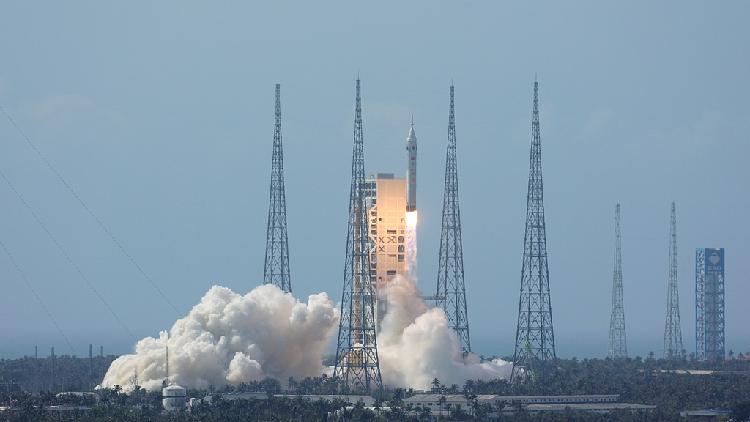
On Feb. 11, 2026 China conducted low-altitude demonstration and validation flights at Wenchang of the Long March-10 rocket and a Mengzhou crewed spacecraft high-speed abort under maximum dynamic pressure; officials reported both prototype systems performed as designed. The mission — the Long March-10’s first ignition flight in its prototype configuration and China’s first max‑Q abort plus first at‑sea splashdown recovery of both a crewed return capsule and a rocket first stage — validated ascent, abort and recovery performance, interface compatibility and reusable-system procedures, delivering flight data and engineering experience that advance China’s stated goal of landing astronauts on the Moon before 2030.
Market structure: China’s successful Long March‑10/Mengzhou tests accelerate state-sponsored crewed lunar capability, widening the gap between sovereign space programs and private commercial launchers. Winners: global defense primes (NOC, LMT, RTX) and ISR/data plays (MAXR) that sell to governments; suppliers of heavy‑lift engines, reusability materials and maritime recovery services. Losers: small-cap commercial launchers and speculative spacetech names whose TAM assumptions (premium Western contracts) face increased geopolitical substitution and pricing pressure over 12–36 months.
Risk assessment: Tail risks include accelerated export controls or sanctions (US/EU vs China), a major test failure causing program delays, or a military escalation that spikes defense spending but disrupts supply chains (semiconductors, specialty alloys). Immediate market reaction (days) will be muted; short term (weeks–months) expect rising defense equity flows and CDS tightening for primes; long term (2–5 years) structural reallocation of R&D and procurement budgets. Hidden dependency: Western suppliers to private space rely on global supply chains—secondary order flow could evaporate if governments redirect procurement.
Trade implications: Favor 6–12 month overweight to defense primes and ISR: selective long NOC/LMT/RTX and MAXR exposure; hedge with put protection against near‑term risk‑off. Consider modest short positions in high‑valuation commercial launch stocks (SPCE, RKLB) via defined‑risk option structures if they fail to win sustained government contracts. Cross‑asset: buy 2–4% allocation to MP Materials (MP) and ATI/AA for strategic materials; expect modest CNY strength on national pride but watch FX volatility around sanctions.
Contrarian: Consensus underestimates buoyancy of non‑US defense budgets—Europe/India may accelerate procurement, benefiting primes with diversified revenue. Reaction may be underdone: market rewards visible sales, not tests; therefore, buy selectively on pullbacks of 5–12% as contracts flow. Beware unintended consequence: overinvestment in hypersonics/crew systems could crowd out commercial smallsat R&D, creating medium‑term consolidation opportunities in the smallsat launch sector.
AI-powered research, real-time alerts, and portfolio analytics for institutional investors.
Request DemoOverall Sentiment
mildly positive
Sentiment Score
0.25
