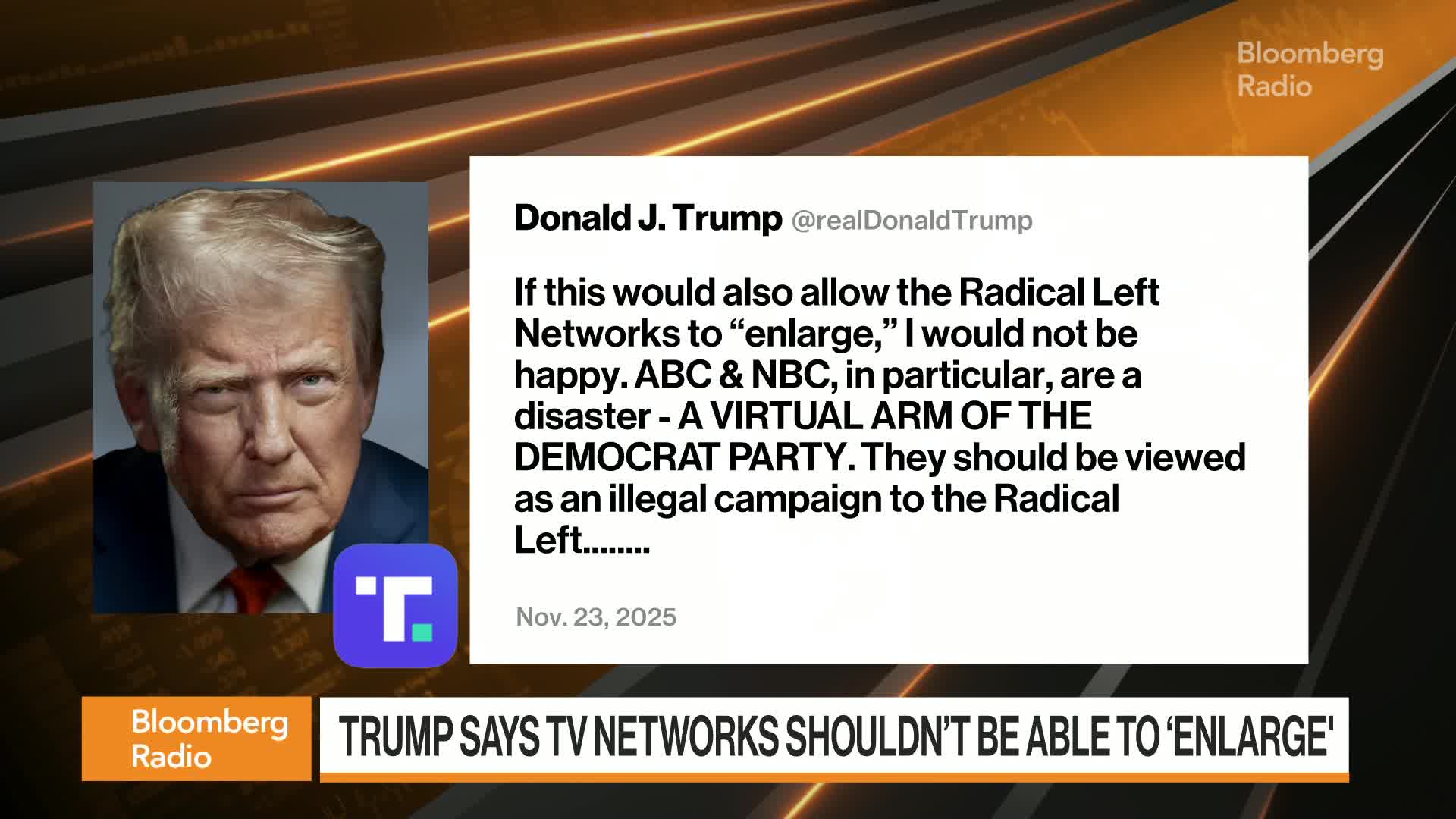
Former President Donald Trump publicly opposed allowing television networks to expand, reacting to a Newsmax report that FCC chair Brendan Carr is advancing actions that would broaden network reach and support a proposed merger between Nexstar Media Group and Tegna Inc. The dispute frames a political and regulatory risk around media consolidation, potentially influencing the prospects and regulatory scrutiny of the Nexstar–Tegna transaction and broader sector consolidation. Bloomberg commentary referenced in the report signals this is a developing policy and political story rather than an immediate financial event.
Market structure: Consolidation raises bargaining leverage for a merged NXST/TGNA over MVPDs and digital distributors, implying a realistic 3–7% uplift to nationwide retrans and political ad CPMs over 12–24 months while reducing local inventory. Direct losers are mid-size independents and pure-play streaming ad platforms that compete for the same local political ad dollars; expect margin dispersion to widen by 200–400 bps across players. Cross-asset: headline volatility will lift equity implied vols by 15–30% for involved tickers, push high-yield media spreads wider by ~20–50bps on regulatory uncertainty, with minimal FX or commodity impact.
Risk assessment: Tail risk includes a DOJ/FCC-ordered divestiture or litigation that could impose conditions causing a 20–40% equity re-rating and >12‑month close delay; conversely, a fast greenlight would compress spreads by >200bps within days. Immediate (0–7 days) risks are headline-driven 5–10% swings; short-term (30–180 days) risks center on filings, committee votes, and campaign season rhetoric; long-term (1–3 years) is market-structure change. Hidden dependencies: financing covenants at >5.0x net leverage, political calendar (election windows), and ad-revenue seasonality—any of which can flip deal economics.
Trade implications: Favor volatility-driven instruments and relative-value plays over simple longs. Use 30–180 day options to express regulatory outcomes (buy puts to cap downside, buy calls as greenlight protection) and consider pair trades that isolate consolidation premium (long NXST vs short SBGI-sized 1:1 for 90–180 days). Rotate 3–7% from pure-play ad-tech/streaming into local-broadcast beneficiaries if spreads narrow >100bps and implied deal probability rises above 60%.
Contrarian angles: Consensus overweights headline political risk; historically (Tribune/ Sinclair) markets overshoot downside then re-rate within 6–12 months if strategic synergies are credible. Mispricing exists when deal-arb spreads exceed 10% for >60 days—signals a tactical short-covering/arbitrage entry. Unintended consequence of a block is surge in private-equity interest, which could bid valuations up by 15–30% and increase leverage risk in the sector.
AI-powered research, real-time alerts, and portfolio analytics for institutional investors.
Request DemoOverall Sentiment
neutral
Sentiment Score
0.00
Ticker Sentiment
