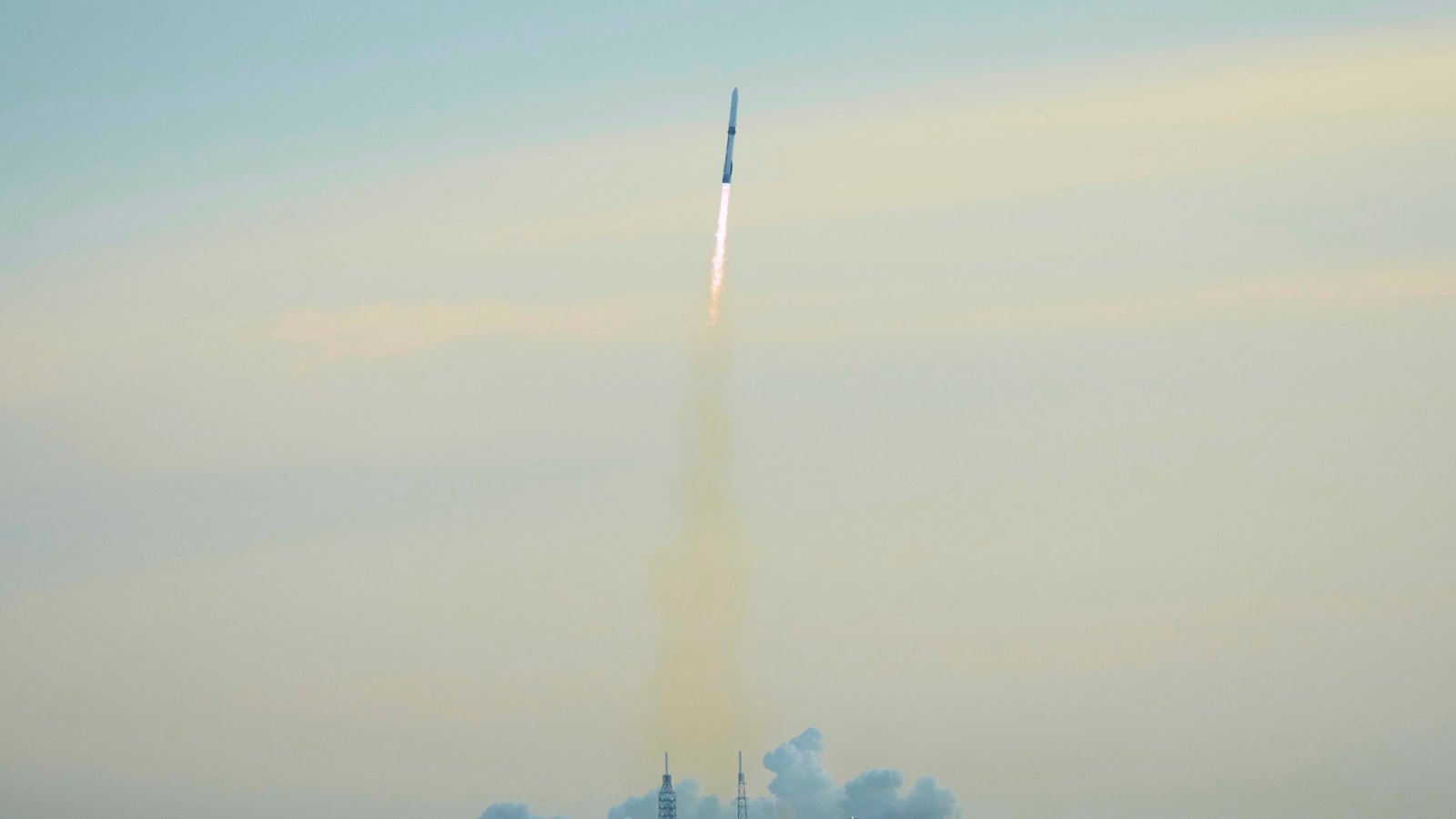
Blue Origin's New Glenn launches are on hold after a failed weekend mission, with preliminary data pointing to an upper-stage engine thrust failure that left a satellite in the wrong orbit and caused it to reenter the atmosphere. This is only the rocket's third flight and adds execution risk to a program NASA is counting on for Blue Moon lunar lander missions. The FAA and Blue Origin are investigating before launches can resume.
This is a credibility event for New Glenn, but the market is likely to underappreciate the asymmetry between a schedule slip and a true capability reset. The immediate economic hit is not just one delayed launch; it is the loss of confidence in Blue Origin’s ability to support high-value, schedule-sensitive payloads, which matters more for commercial customers than for one-off mission counts. That raises the bar for every subsequent New Glenn booking and increases the probability that customers demand redundancy, discounts, or contractual escape hatches.
The second-order loser is ASTS, where launch reliability is part of the operating thesis, not a side issue. For a company building a network effect, every slip compounds because constellation economics improve nonlinearly with deployed satellites; a launch failure pushes out service milestones, delays revenue inflection, and can force more expensive interim capacity or insurance. The bigger overhang is financing: if cadence uncertainty persists into the next 1-2 quarters, investors will likely haircut terminal deployment assumptions and widen the cost of capital.
The relative winner is SpaceX, even if not directly mentioned, because this reinforces the scarcity value of proven lift capacity. In a market where launch slots and reliability matter more than raw aspiration, incumbency compounds — especially for national security, NASA, and commercial customers who cannot tolerate repeated mission resets. Over a 6-12 month horizon, this should also help SpaceX preserve pricing power and bargaining leverage on long-duration contracts.
The contrarian read is that this may be less of a platform-level indictment than a one-engine anomaly, so the selloff in ASTS could overshoot if investors extrapolate a near-term launch delay into a multi-quarter thesis break. The key tell is whether Blue Origin can restore confidence quickly with a clean root-cause explanation and a short return-to-flight window; if so, the current derating may reverse faster than consensus expects. If not, the risk shifts from technical to commercial execution, which is far more damaging.
AI-powered research, real-time alerts, and portfolio analytics for institutional investors.
Request DemoOverall Sentiment
moderately negative
Sentiment Score
-0.45
Ticker Sentiment
