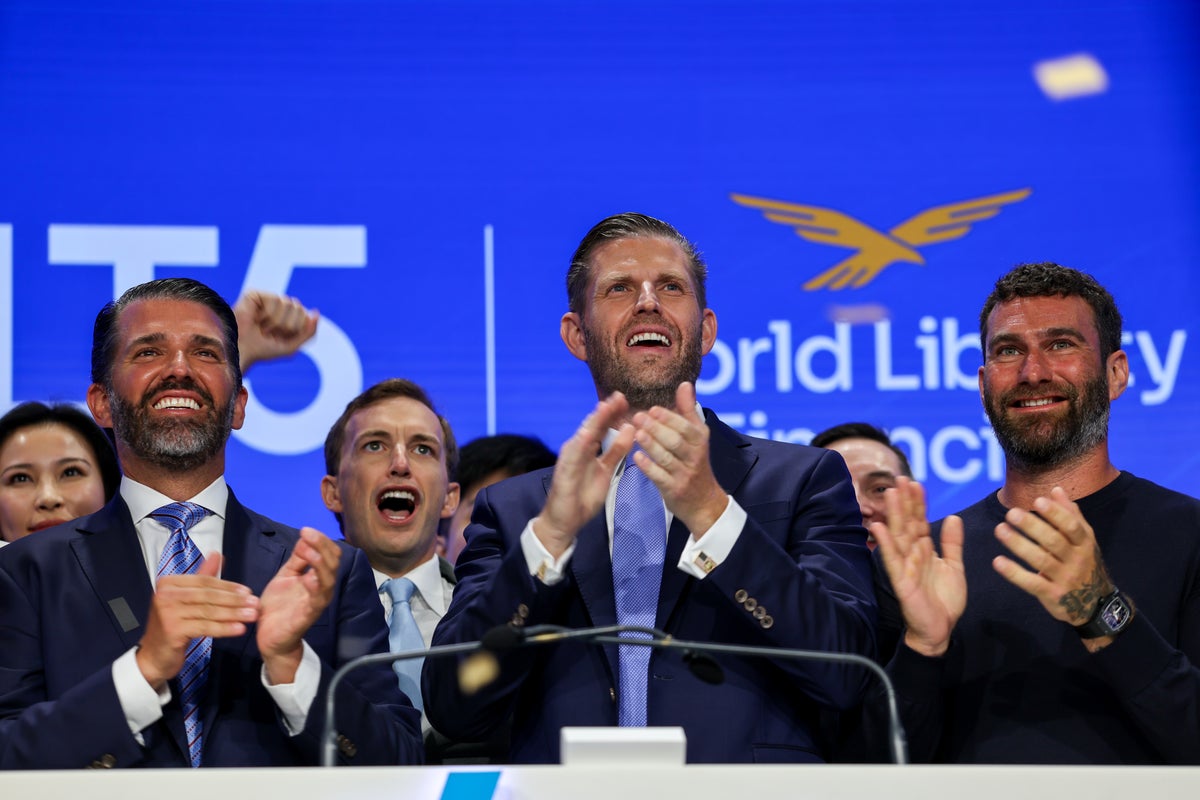
Justin Sun has filed a fraud lawsuit against World Liberty Financial, alleging his $45 million token investment was obtained through fraud and that his tokens and voting rights were improperly frozen after he رفض a governance proposal requiring 10% of advisers’ tokens to be burned. The complaint claims hundreds of millions of dollars in damages, says WLF is on the verge of collapse and severe financial insolvency, and seeks a jury trial plus injunctive relief to unfreeze the tokens. The case adds to governance and conflict-of-interest scrutiny around the Trump-linked crypto venture and could pressure sentiment in the token project, though broader market impact is likely limited.
This is less a TRON-specific fundamental event than a credibility shock to the broader political-crypto complex. The second-order effect is that governance risk now looks like balance-sheet risk: if tokenholders believe insiders can rewrite rules, freeze assets, and reallocate economics, discount rates across adjacent “brand-backed” crypto ventures should rise sharply. That favors established protocols with transparent on-chain governance and hurts venture-style tokens that trade more like illiquid equity with legal overhang.
The immediate market impact likely shows up in three places over days to weeks: widening spreads in politically affiliated tokens, lower primary issuance appetite for celebrity/brand-led launches, and a higher probability of forced de-risking by market makers who don’t want headline gamma. The TRON link is important because Sun’s regulatory reprieve introduces a reflexive loop: any renewed legal pressure can rapidly hit liquidity and market access, while any perception of political protection can do the opposite. That asymmetry makes the token complex vulnerable to sharp air pockets even if the underlying allegation set is unresolved.
The contrarian read is that the headline may ultimately strengthen Sun’s bargaining position if the case accelerates a settlement and unfreezes assets, which would be a tactical positive for TRON liquidity. But the base case for the next 1-3 months is that governance controversy keeps a lid on multiple expansion for politically exposed crypto names, especially those reliant on discretionary token economics rather than organic usage. This is a classic “regulatory blessing is not a moat” setup: any relief is temporary, while reputational damage compounds into higher financing costs and weaker secondary demand.
AI-powered research, real-time alerts, and portfolio analytics for institutional investors.
Request TrialOverall Sentiment
strongly negative
Sentiment Score
-0.70
Ticker Sentiment
