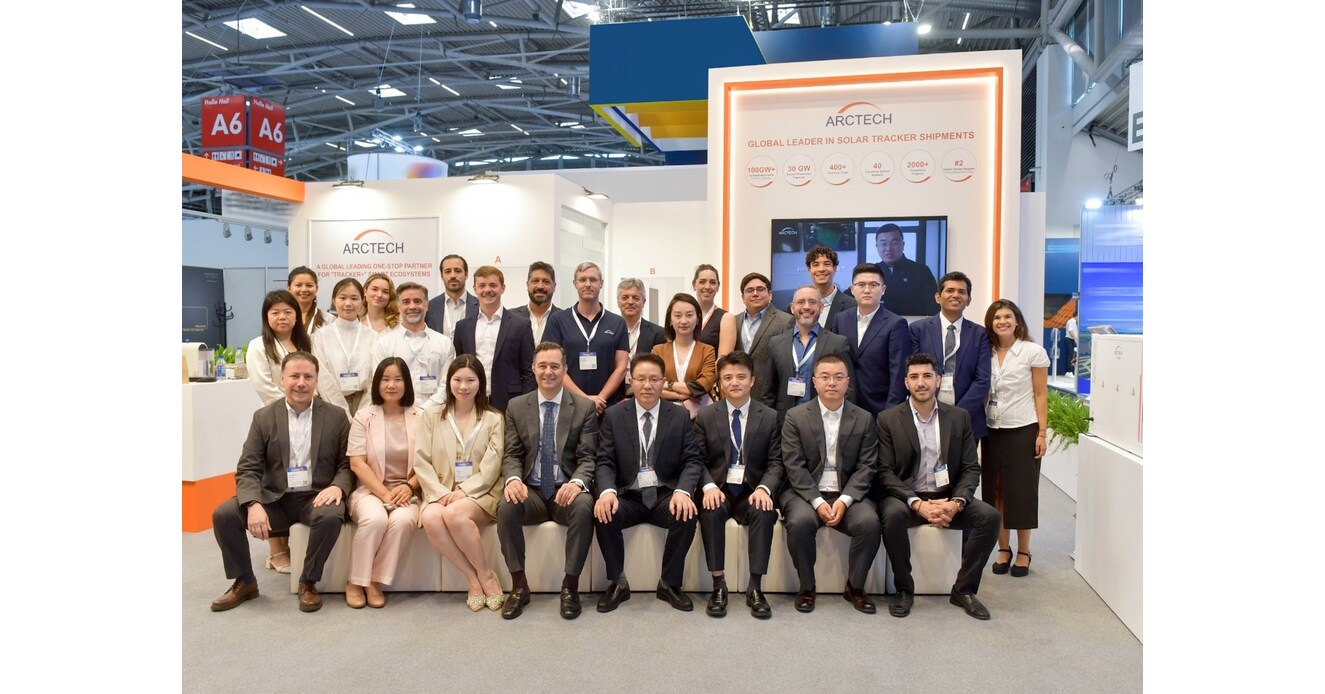
Arctech showcased its “Tracker+” solar tracking ecosystem at Intersolar Europe 2026, including SkyLine II, SkySmart II (AI-driven wind stow protection), Star Shine autonomous cleaning, and SkyFlex cable mounting. The company cited European deployments totaling 342MW (Romania), 67MW (Romania), 266MW (Greece), and 52MW (Poland), and announced new project signings totaling 132MW in Türkiye and Zambia. It also highlighted the Arctech Verification Base (AVB) in Puertollano, Spain, aimed at validating performance under real European weather conditions.
The meaningful signal here is not incremental Europe demand; it is mix shift. If complex terrains, wind-stow requirements, and agrivoltaics become a larger share of installed MW, the winners are the tracker vendors that can monetize engineering intensity, software, and O&M attach rates rather than compete purely on steel cost. That tends to favor higher-quality platforms like NXT over more price-sensitive names like ARRY, while also lifting niche beneficiaries in cleaning robotics, controls, and localized EPC services.
But this is still a trade-show narrative, not a backlog update. The immediate market impact should be muted because the article does not establish conversion into binding orders, margin uplift, or a new pricing cycle; it mainly confirms that competition in Europe remains intense and that product differentiation matters. The second-order risk is that more capable entrants compress ASPs even as they expand the addressable market, capping gross margin expansion for the whole tracker group.
Time horizon matters: over the next 1-3 months, the catalyst is only visible if earnings calls show Europe mix, order intake, or service revenue inflecting. Over 6-18 months, the structural upside is for firms that can sell lifecycle optimization, not just hardware, while the downside is slower project monetization due to permitting/grid bottlenecks. The contrarian view is that the market may be overestimating how quickly ‘advanced’ solar features translate into revenue; without evidence of higher margin capture, this remains mostly a competitive signal, not a demand shock.
AI-powered research, real-time alerts, and portfolio analytics for institutional investors.
Overall Sentiment
mildly positive
Sentiment Score
0.25
