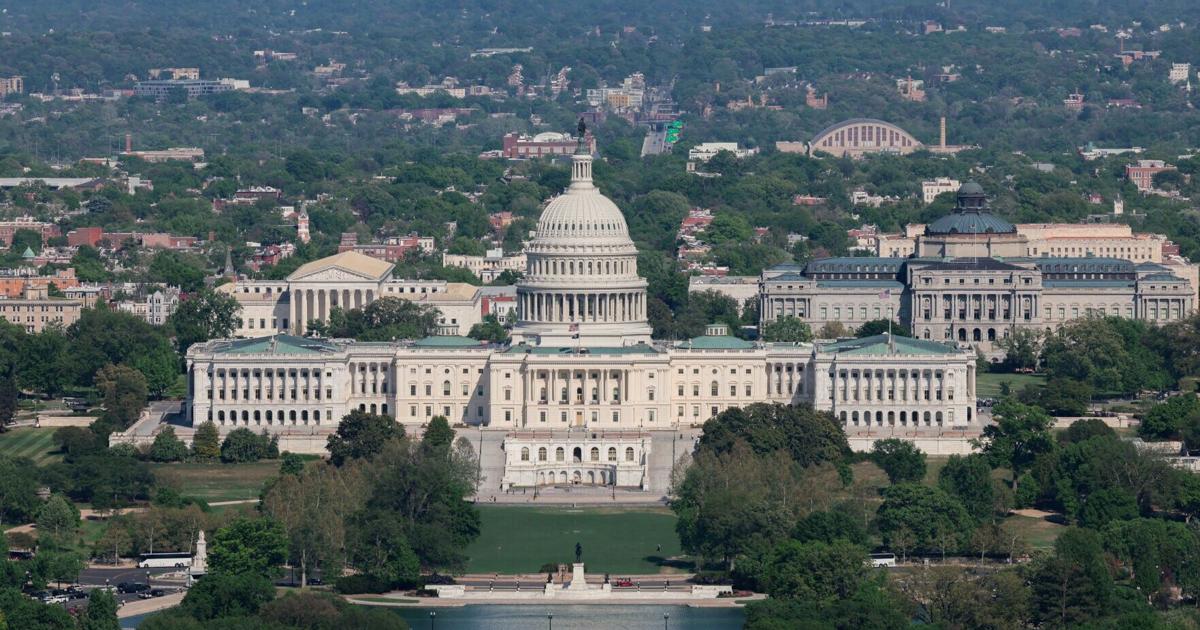
Lawmakers advanced a non-binding budget resolution tied to a $70 billion DHS funding package, clearing the Senate 50-48 and sending it to the House. The plan would fund DHS through January 2029 via budget reconciliation, but it remains politically contentious over ICE and Border Patrol rules, with Democrats opposed and House passage still uncertain. The vote underscores the broader budget and immigration standoff ahead of the midterm elections.
The key market implication is not the funding amount itself, but the procedural shift: reconciliation dramatically lowers the odds of a prolonged shutdown and gives Republicans a cleaner path to fund enforcement priorities without needing bipartisan cover. That reduces near-term headline risk for contractors and vendors tied to immigration enforcement, while increasing the probability of a larger, more durable discretionary spend envelope that could persist through the next presidential term.
The second-order effect is political rather than operational: this becomes a wedge issue heading into the midterms, and the vote-a-rama signals that healthcare affordability will remain the stronger electoral narrative. That matters for healthcare and consumer-sensitive sectors because any extended messaging around costs, coverage, and household budgets tends to keep pressure on insurer margins, hospital reimbursement optics, and retail sentiment, even if legislation itself stalls.
For ICE specifically, the market is likely underappreciating the asymmetry between appropriated dollars and execution risk. A larger funding base is positive for mission-critical software, detention logistics, identity verification, and transport capacity, but it also raises the odds of legal challenges, procurement delays, and public scrutiny that can slow contract conversion. The better trade is not a pure directional bet on immigration enforcement policy; it is a relative-value expression on firms with existing DHS exposure and high contract visibility versus lower-quality names that need new awards to re-rate.
The contrarian miss is that the legislative path may be easier than the political path. If Republicans can keep reconciliation on track, the next catalyst is not passage but committee-level allocation, which could create a multi-week window where defense and public-safety vendors grind higher while broader markets ignore the issue. The main reversal risk is a court injunction, a high-profile enforcement incident, or House defections that re-open shutdown odds within days to weeks.
AI-powered research, real-time alerts, and portfolio analytics for institutional investors.
Request TrialOverall Sentiment
neutral
Sentiment Score
-0.05
Ticker Sentiment
