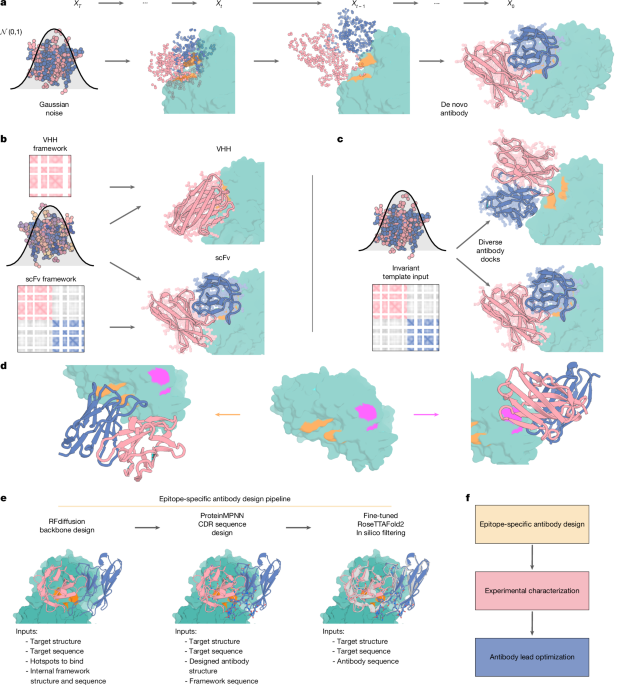
A novel computational method utilizing a fine-tuned RFdiffusion network has demonstrated the de novo design of epitope-specific antibodies, including VHHs and scFvs, with atomic-level precision, marking a significant advancement in the rapidly expanding $445 billion antibody therapeutics market. This innovation offers a faster and more cost-effective alternative to traditional, laborious antibody discovery processes, enabling the targeting of previously intractable clinical epitopes. Experimental validation through cryo-electron microscopy confirms the atomic accuracy of these designs, positioning this approach to revolutionize drug development by enhancing discovery efficiency and optimizing critical pharmaceutical properties.
The article details a significant advancement in de novo antibody design, leveraging a fine-tuned RFdiffusion network to create epitope-specific antibodies, including VHHs, scFvs, and full antibodies, with atomic-level precision. This innovation directly addresses the inefficiencies of traditional antibody discovery methods, which are laborious and time-consuming, within a global antibody therapeutics market projected to reach US$445 billion in the next five years. The ability to precisely target specific epitopes is critical for developing novel therapeutics, such as antagonists or modulators, and for accessing previously intractable clinical targets.
Experimental validation, including cryo-electron microscopy, confirmed the atomic accuracy of designed VHHs for influenza haemagglutinin and Clostridium difficile toxin B, and scFvs for TcdB. While initial computational designs exhibited modest affinities (tens to hundreds of nanomolar Kd), subsequent affinity maturation using OrthoRep3 successfully yielded single-digit nanomolar binders. This demonstrates the method's capability to produce therapeutically relevant molecules and its broad applicability, as shown by the design of scFvs for the challenging PHOX2B peptide–MHC complex.
This technology is poised to revolutionize antibody discovery by accelerating development, potentially increasing the number of viable clinical targets, and improving key pharmaceutical properties like aggregation and solubility. Although current experimental success rates are low, retrospective analysis indicates that integrating advanced filtering tools like AlphaFold3 could significantly enhance design efficiency. Future improvements will focus on optimizing initial design affinity, enhancing sequence humanization to reduce immunogenicity, and refining generative models.
AI-powered research, real-time alerts, and portfolio analytics for institutional investors.
Request DemoOverall Sentiment
extremely positive
Sentiment Score
0.85
Ticker Sentiment
