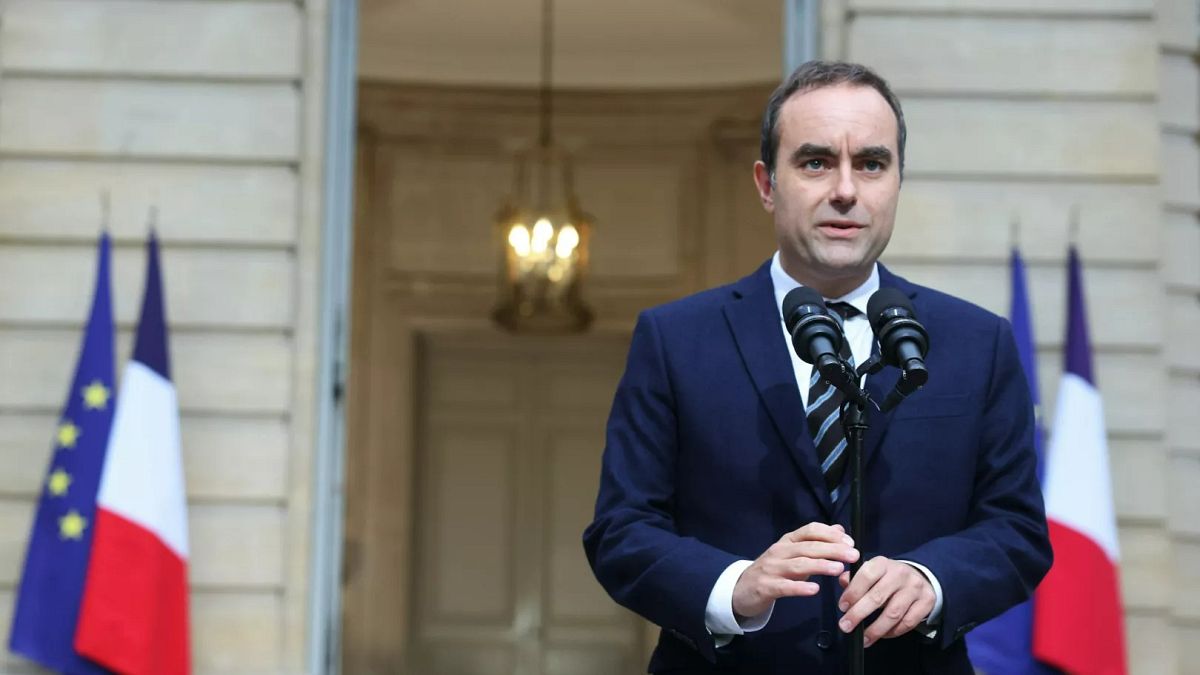
French Prime Minister Sébastien Lecornu has completed his cabinet formation, appointing Bruno Le Maire as Armed Forces Minister and Roland Lescure to head the critical Bercy ministry (Economy/Finance), while retaining several key allies amidst protests over public spending cuts. Facing a lack of parliamentary majority, Lecornu has pledged not to use Article 49.3 for budget passage, a significant concession that has not appeased opposition parties, signaling continued political fragility and potential legislative challenges ahead of his anticipated general policy speech.
Amid protests, Lecornu finalised the cabinet with Bruno Le Maire as the armed forces minister. President Macron's allies retain posts, and a general policy speech is awaited. New French Prime Minister Sébastien Lecornu has, in part, completed assembling his cabinet after facing mounting pressure and several weeks of intense nationwide protests over his proposed public spending cuts. An initial salvo of 18 ministers was announced on Sunday evening by Emmanuel Moulin, Secretary General of the Élysée Palace. At the start of the consultations initiated by Matignon, the little intrigue surrounding this new government concerned whether or not Rachida Dati would remain in office, in the midst of a judicial storm, as well as the name of the person who would take over the Armed Forces from Sébastien Lecornu. As the timetable progressed, the demands of Macron's de facto allies became increasingly pressing. Worried about pressure from the left on economic issues, the leader of the Republicans and resigning minister of the interior Bruno Retailleau warned that the right's participation "was not a given at all". This threat did not materialise, however, as several Les Républicains (LR) ministers retained their posts, including Retailleau continuing as interior minister and Gérald Darmanin as minister of justice. In a surprise appointment, the Ministry of the Armed Forces and Veterans' Affairs was given to Bruno Le Maire, the former minister of economy. In a small sign of change, many Macronist ministers remain in government, includin Jean-Noël Barrot, minister for Europe and foreign affairs, and Élisabeth Borne, as education minister. Éric Lombard has been replaced at the head of Bercy by Roland Lescure, former minister of industry between 2022 and 2024, now a Macronist MP for the French abroad in the US and Canada. While Manuel Valls will remain in charge of overseas territories, the other figure from the left wing of the outgoing government, François Rebsamen, announced on Saturday that he had informed the prime minister of his decision not to be part of his government, citing his "convictions as a left-wing, progressive man". Eric Woerth, a former Sarkozy minister, will inherit the portfolio. Macron will convene the new government at a Council of Ministers meeting on Monday at 4 pm, according to the Élysée Palace. Lecornu to face Parliament on Tuesday The appointment of the government, whether in one or several parts, is an inescapable step before the general policy speech, which is set to take place on Tuesday and is eagerly awaited by the opposition. Deprived of a majority in the National Assembly, Lecornu, who described himself as "the weakest prime minister of the Fifth Republic" promised to "renounce" the use of Article 49.3 of the constitution to pass his budget. "In a parliament that works, that was renewed more than a year ago, that resembles the French, you cannot force your way through and you cannot coerce your opposition", Lecornu said in a speech on Friday. This announcement was not enough for the Le Parti socialiste (PS), whose first secretary, Olivier Faure, already sees a clear path "towards censure": in the absence of a Zucman tax, even if watered down, the reintroduction of the wealth tax or the suspension of an unpopular pension reform. The far-right National Rally (RN) leader Marine Le Pen hailed the non-use of Article 49.3 but hinted that the address would be decisive. "No one is waiting for the ministers, which is actually a real problem. In a democracy, you think there's some kind of interest in who's going to be a minister. Here, no one feels the slightest suspense about the potential appointment of ministers", Le Pen said. "It's the general policy speech that is really expected", she insisted on Friday. The left-wing France Unbowed (LFI), which continues to call for Macron to resign, had promised to table a motion of censure regardless of the government's composition and the roadmap presented to MPs on Tuesday. The formation of French Prime Minister Sébastien Lecornu's new cabinet occurs within a context of significant political fragility and heightened fiscal pressure, underscored by a moderately negative sentiment score (-0.45) and an uncertain tone. The government, which lacks a majority in the National Assembly, faces nationwide protests against proposed public spending cuts. A critical development is the Prime Minister's pledge to renounce the use of Article 49.3 for passing the budget, a major concession that removes the executive's key tool for bypassing parliamentary opposition. This move has failed to appease opposition parties, with the Socialists (PS) and France Unbowed (LFI) already signaling their intent to pursue motions of censure. The appointment of Roland Lescure to head the Bercy (Economy/Finance) ministry is notable, placing him at the forefront of these impending legislative battles. The government's immediate survival hinges on the Prime Minister's upcoming general policy speech, which will serve as a crucial test of his ability to govern and avoid legislative paralysis or a vote of no confidence.
AI-powered research, real-time alerts, and portfolio analytics for institutional investors.
Request DemoOverall Sentiment
moderately negative
Sentiment Score
-0.45
