
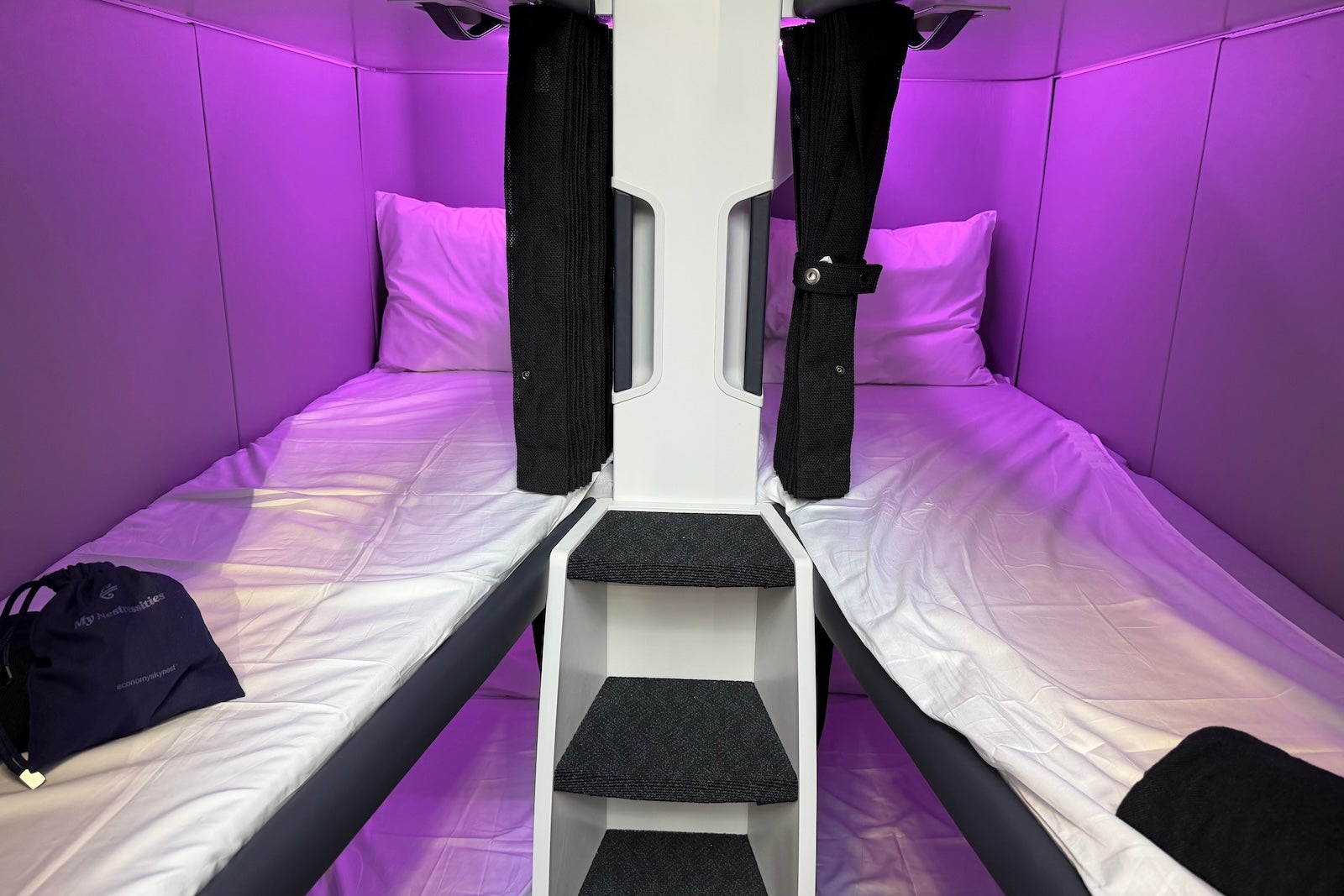
Air New Zealand plans to launch its Skynest bunk-bed product on select ultra-long-haul Dreamliner flights between JFK and Auckland, with tickets set to go on sale May 18 and first flights targeted for November 2026. The product will cost $495 for a four-hour block and be available to economy and premium economy passengers ages 15 and up. The announcement highlights an incremental premium-service innovation rather than a material near-term financial catalyst.
This is less a direct earnings event for UAL than a signal that premium monetization in long-haul coach is still under-engineered. If an airline can charge roughly $500 for four hours of horizontal rest, the implied willingness-to-pay for sleep equity on 14-18 hour sectors is far higher than legacy carriers have been extracting from economy cabins. The second-order takeaway is that product differentiation in ultra-long-haul is shifting from seat pitch to ancillary comfort inventory, which raises the bar for network carriers that rely on price dispersion rather than true cabin segmentation.
For UAL specifically, the near-term financial impact is negligible, but the strategic pressure is real because JFK-AKL is a high-visibility route where customer expectations get set for transpacific and polar flying. United’s competitive risk is not losing this exact market share; it’s the gradual erosion of premium economy upsell and Polaris differentiation if competitors normalize bookable sleep products and then cascade the concept to more routes. The more important knock-on effect is in aircraft interior supply chains: if this proves sticky, it supports longer-term demand for modular cabin retrofits, inflight power, linens/amenity vendors, and certification services rather than simply more seats.
The contrarian view is that the concept may be more PR-efficient than economically scalable. A six-bed pod sounds compelling, but the operational friction is high: boarding complexity, cleaning turnover, liability, and the opportunity cost of sacrificing revenue-generating seats or galley space. That makes adoption likely to remain niche for years, which means the market may overestimate how quickly rivals need to respond. In the meantime, the real trade is not on the novelty itself but on which carriers can translate comfort features into measurable RASM lift without materially reducing density.
Catalyst horizon is months to years, not days. The first test is whether the product sells out consistently and at what attach rate versus premium economy fare premiums; if utilization is weak, the idea stays a marketing story. If it works, expect copycat products and incremental CAPEX commitments across long-haul fleets over 12-24 months, with the biggest beneficiaries being those already selling premium cabin experiences efficiently.
AI-powered research, real-time alerts, and portfolio analytics for institutional investors.
Request TrialOverall Sentiment
mildly positive
Sentiment Score
0.35
Ticker Sentiment
