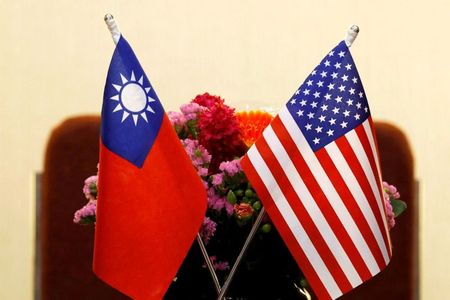
The reported $14 billion Taiwan arms package is facing renewed scrutiny after testimony suggested a pause tied to U.S. ammunition reserves, though a source pushed back and said the sales remain separate from Middle East operations. President Trump has not yet decided on approval, adding near-term uncertainty for defense contractors exposed to Taiwan-related orders. Taiwan said it has not received any official delay notice.
NVDA’s near-term risk is less about direct revenue leakage and more about headline-driven multiple compression: when export-control or authorization risk rises, the market tends to de-rate the entire AI complex first and sort out fundamentals later. That matters because NVDA’s valuation is still highly sensitive to incremental policy uncertainty, even if the underlying order book is intact; a one-step change in perceived geopolitical optionality can move 5-10% in the stock before any actual shipment impact appears.
The second-order effect is on the broader infrastructure stack. If investors conclude that Washington is willing to use defense approvals as a geopolitical lever, it raises the probability of tighter scrutiny on advanced compute exports, integration partners, and dual-use supply chains. That could pressure companies with China exposure more than pure AI beneficiaries, while semis with cleaner end-market mix may catch a relative bid.
The contrarian read is that the market may be overestimating the operational linkage and underestimating the political theater. If the administration issues a clean approval or even a delayed-but-not-denied determination, the unwind in NVDA could be fast because positioning has likely already moved defensive. In that scenario, the stock can recover quickly on relief rather than on revised growth estimates, which tends to create sharper upside than the original downside move.
Time horizon matters: the immediate trading window is days to a few weeks, but the bigger question is whether this becomes a template for broader export-control tightening over months. A genuine policy shift would not just hit NVDA sentiment; it would increase the discount rate applied to the entire AI capex cycle, especially names with heavier China regulatory exposure.
AI-powered research, real-time alerts, and portfolio analytics for institutional investors.
Request DemoOverall Sentiment
mildly negative
Sentiment Score
-0.15
Ticker Sentiment
