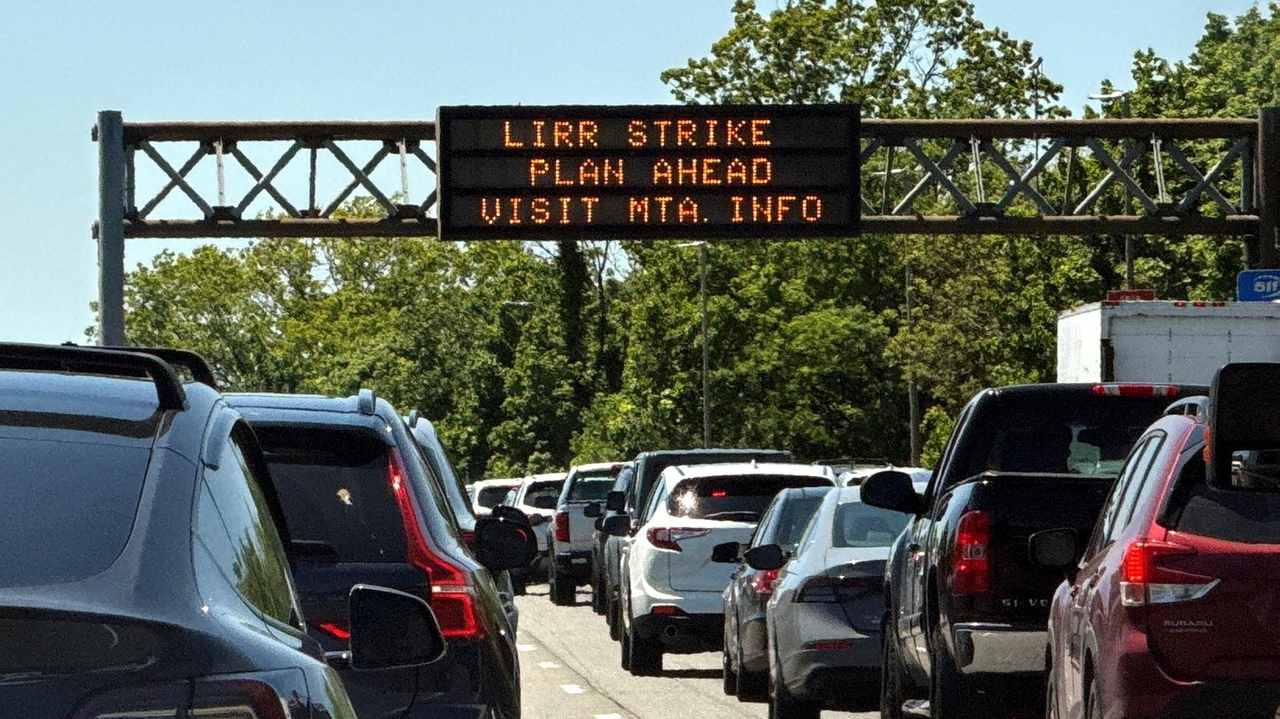
The article highlights disruption from an LIRR strike, with commuters and businesses facing longer travel times and higher economic costs across Long Island roads. Union members are picketing for a new contract, underscoring labor tensions and operational uncertainty. The impact appears localized rather than market-wide, but it is negative for transportation efficiency and regional commerce.
The market impact here is less about the rail line itself and more about the temporary re-pricing of regional mobility. A strike-like disruption pushes discretionary trips, last-mile deliveries, and labor attendance costs onto the road network, which creates a short-lived but measurable benefit for highway-oriented operators and a hidden tax on employers with dense commuter footprints. The second-order winner is anyone monetizing delay: toll roads, parking operators, ride-hail fleets, and certain convenience retail nodes near major arteries should see incremental volume, while local consumer demand is merely deferred rather than destroyed.
The more interesting economic signal is not the lost commuting time; it is the elasticity test on suburban labor. If employers start absorbing higher absenteeism or remote-work accommodations, the event becomes a data point for structurally lower peak transit demand and a stronger case for decentralized office footprints. That has negative implications for transit-adjacent real estate, but positive implications for road-maintenance, logistics, and flexible-work infrastructure over a multi-quarter horizon.
Tail risk is political resolution: once a contract path appears, the tradeable dislocation compresses quickly, likely within days. The bigger-than-consensus risk is that the market overestimates the duration of the disruption and underestimates how quickly commuters normalize through carpooling, staggered shifts, and WFH substitution. So this is a tactical event trade, not a thesis on permanent mode shift, unless the labor issue reappears repeatedly and starts changing employer behavior in a durable way.
Contrarian angle: the obvious bearish read is on local economic activity, but most of that revenue is not lost, just re-timed. If the disruption persists even a few sessions, the real alpha is in congestion monetization and in businesses with pricing power over urgency, not in broad regional retail or consumer exposures. The move is likely underpriced on day one, but overextended if positioned as a months-long macro shock.
AI-powered research, real-time alerts, and portfolio analytics for institutional investors.
Request DemoOverall Sentiment
mildly negative
Sentiment Score
-0.20
