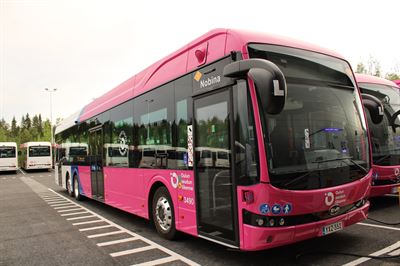
Nobina has won an extended eight-year (plus two-year option) contract with Oulu Regional Transport to operate city and regional bus services from June 2027, comprising 24 fully electric buses as part of a fossil-free public-transport push. The award strengthens Nobina’s presence in Oulu and its zero-emission vehicle rollout; the decision can be appealed until 5 February 2026. While strategically positive for the company’s ESG positioning and operations in Finland, the contract is modest in scale relative to group sales of ~SEK 14 billion (2024/2025) and is unlikely to materially affect near-term financials.
Market structure: This contract is a small but repeatable revenue win for Nobina (NOBINA.ST) and a positive signal for electric-bus OEMs and charging-infrastructure suppliers (beneficiaries: VOLV-B.ST for Volvo Buses, ABB.N for chargers). The direct financial impact is modest (24 buses) but the procurement cadence and 8+2 year term shorten payback for capex-heavy operators and increases pricing power for reliable EV suppliers over the 2027-2035 horizon. Expect municipal buyers to increasingly favor total-cost-of-ownership (TCO) bids, pressuring legacy diesel suppliers' margins by ~200–400bps over several years.
Risk assessment: Near-term tail risk is an appeal (deadline 2026-02-05) that could delay revenue recognition and depress sentiment; medium-term risks include battery supply delays, grid-connection bottlenecks, and electricity price spikes that could raise opex by 5–15%. Immediate (days) market moves should be muted; short-term (weeks–months) focus on legal/appeal outcomes and supplier delivery schedules; long-term (years) risk is regulatory reversal or faster-than-expected competitor scaling. Hidden dependency: municipal finance cycles and grant availability drive fleet replacement rates — a 1-year pause in subsidies would materially slow uptake.
Trade implications: Tactical ideas include a small long in NOBINA.ST (to capture contract-steady backlog) and a paired overweight in EV infrastructure (ABB.N or VOLV-B.ST) to ride charging-installation revenue over 12–24 months. Use asymmetric option exposure (9–12 month OTM calls or call spreads sized to 0.5–2% of portfolio) versus small cash positions to limit downside while keeping upside optionality tied to accelerating tenders. Reallocate 2–4% from fossil-heavy transport suppliers into industrials/infra and battery-metal exposure (LIT ETF) to reflect structural capex flows.
Contrarian angles: The market may underweight the signaling effect — 24 electric buses is operational proof that municipalities will contract recurrently; suppliers and battery-metal names could be underpriced by 10–30% relative to long-term demand. Conversely, the obvious green trade underestimates grid and capex churn: winners will be infrastructure integrators, not every OEM, so avoid broad-brush “EV OEM” longs. Historical parallels (municipal bus electrification in Madrid/London) show small tenders preceded multi-year fleet waves; a staged accumulation strategy captures this without overpaying now.
AI-powered research, real-time alerts, and portfolio analytics for institutional investors.
Request DemoOverall Sentiment
mildly positive
Sentiment Score
0.30
