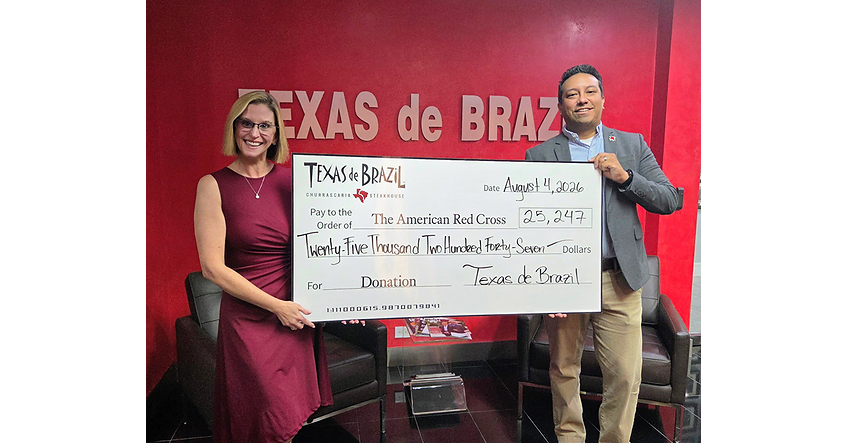
Texas de Brazil highlighted its ongoing partnership with the American Red Cross, praising the Red Cross’s support for military members, veterans, and their families. The article frames the effort as continued corporate giving and community support but provides no financial figures or measurable impact, suggesting minimal market impact.
This is effectively a brand-maintenance announcement, not an earnings catalyst. The only economically relevant effect is incremental local goodwill, which can help a private restaurant concept at the margin with customer retention and employee pride, but it does not move unit economics unless it translates into higher traffic, higher check, or lower labor turnover over multiple quarters.
For public comps, the second-order impact is mostly competitive noise: if Texas de Brazil is strengthening its community presence, nearby premium-occasion chains like TXRH, DRI, and BLMN may face slightly more localized brand competition in Texas and the Southeast, but the overlap is too small to justify a sector view. The more important mechanism is ESG optics: investors should not assign valuation credit to a PR-backed donation campaign unless it is part of a measurable program that improves same-store sales or hiring efficiency.
Time horizon matters here. In the next few days, there should be no price reaction in public names. Over 1-3 months, the only thing to watch is whether management uses community initiatives to support local marketing during a softer discretionary spending environment. Over 6-18 months, this kind of initiative can matter if it becomes a repeatable customer-acquisition lever, but absent data on traffic lift or retention, it is not investable on its own.
Contrarian view: the market often over-rewards generic ESG/CSR messaging by assuming reputational upside is durable. In restaurants, reputation only matters if it changes booking behavior, catering, or hiring costs; otherwise it is just low-cost publicity. The signal would become more meaningful only if paired with quantifiable comps strength, margin resilience, or expansion plans into higher-value markets.
AI-powered research, real-time alerts, and portfolio analytics for institutional investors.
Request DemoOverall Sentiment
neutral
Sentiment Score
0.10
