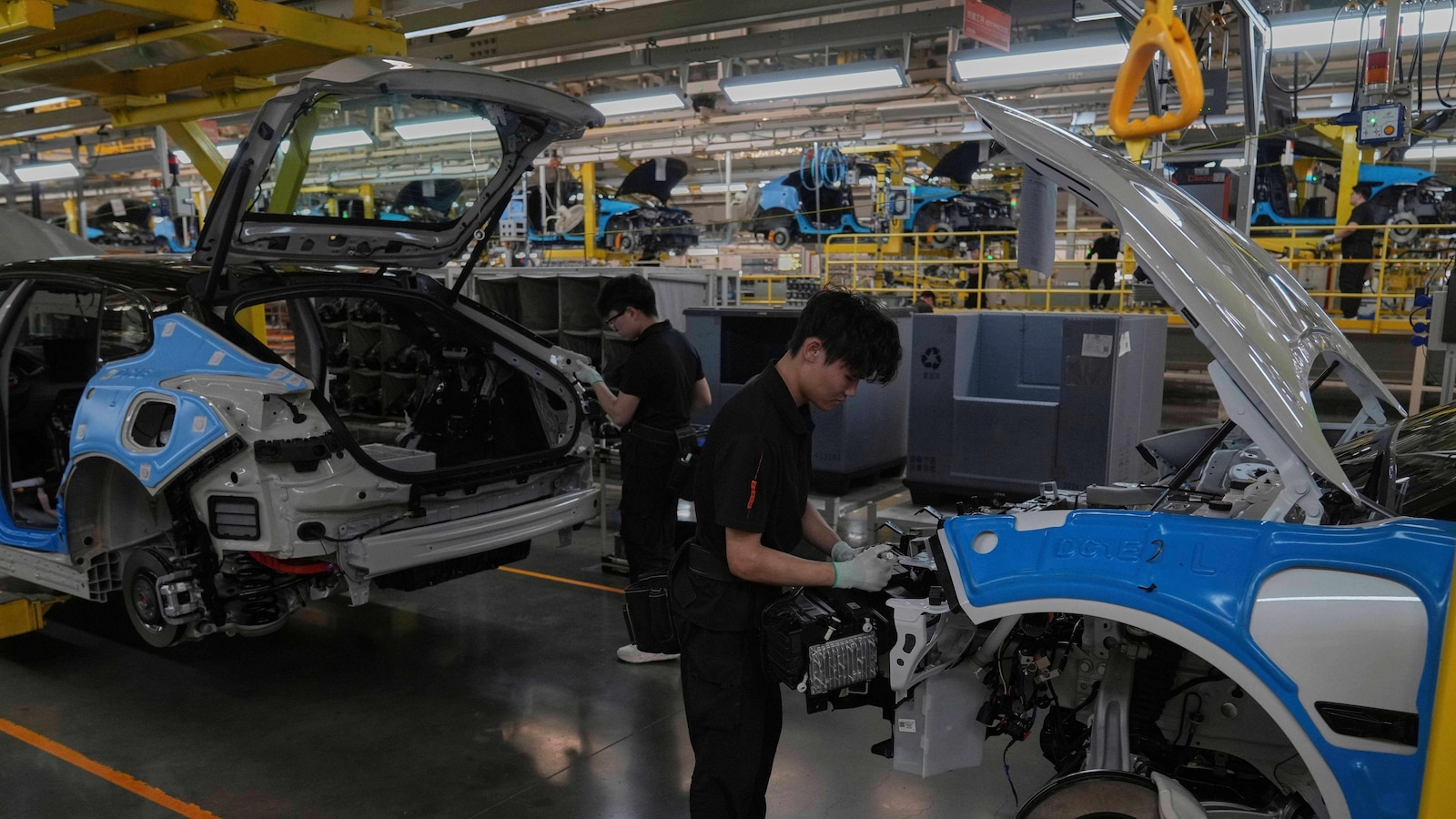
The EU and China have agreed procedural steps and a guidance document for Chinese EV exporters to submit price offers, including specified minimum import prices, as Brussels seeks to resolve a dispute that led to tariffs of up to 35.3% in 2024. The move aims to address alleged subsidy-driven injurious effects while allowing Chinese brands continued access; battery-powered car imports to Europe rose from $1.6bn in 2020 to $11.5bn in 2023, and China-made car share in the EU reached 6% in H1 2025 (vs. 5% a year earlier). The EU said offers will be assessed under WTO rules and will factor Chinese investment plans in the bloc, a development that may temper trade tensions and influence valuations for European OEMs, battery and raw-material suppliers, and Chinese exporters.
Market structure: The EU guidance effectively creates a managed-price corridor that lets low-cost Chinese OEMs continue exporting while capping the worst tariff scenarios; winners are China-based manufacturers (BYD/BYDDF/BYDDY exposure) and non-EU factories of Tesla (TSLA), losers are margin-sensitive European OEMs (VW, BMW, Stellantis) facing renewed price pressure. Expect downward pressure on EU OEM ASPs of 3–7% in the next 12 months if Chinese volumes continue to grow to ~10% market share by 2030; battery/commodity demand remains structurally positive, keeping upstream pricing supported.
Risk assessment: Tail risks include a reversal to full punitive tariffs (reimposition >30–35%) or WTO/retaliatory measures leading to supply-chain bifurcation; probability moderate but impact severe for globally integrated OEMs. Near-term (days–weeks) the market will price headline approvals; medium-term (3–12 months) volume impacts and margin compression materialize; hidden dependency: European chip and rare-earth sourcing from China creates political friction that can flip policy quickly.
Trade implications: Tactical trades favor long exposure to TSLA and selected battery miners (ALB, LTHM) and short European OEM equities (VOW3.DE, BMW.DE) on a 3–12 month horizon; use 6–9 month call spreads on TSLA (25%–45% OTM) to capture asymmetric upside while limiting premium. FX/bonds: overweight USD vs EUR (short EUR/USD) in case German industrial PMI weakens; consider widening credit protection on German auto debt if negotiations sour.
Contrarian view: The consensus underestimates the EU’s need for affordable EVs — the guidance likely prevents a full trade blockade, meaning Chinese volume growth is underpriced and European OEM multiple compression is underdone. Historical parallel: 2010–15 solar panel disputes show managed settlements sustain low-cost imports for years; unintended consequence: accelerated localization of battery cell production in EU (benefit to CATL partners, local gigafactory suppliers) creating new winners within Europe.
AI-powered research, real-time alerts, and portfolio analytics for institutional investors.
Request DemoOverall Sentiment
neutral
Sentiment Score
0.05
Ticker Sentiment
