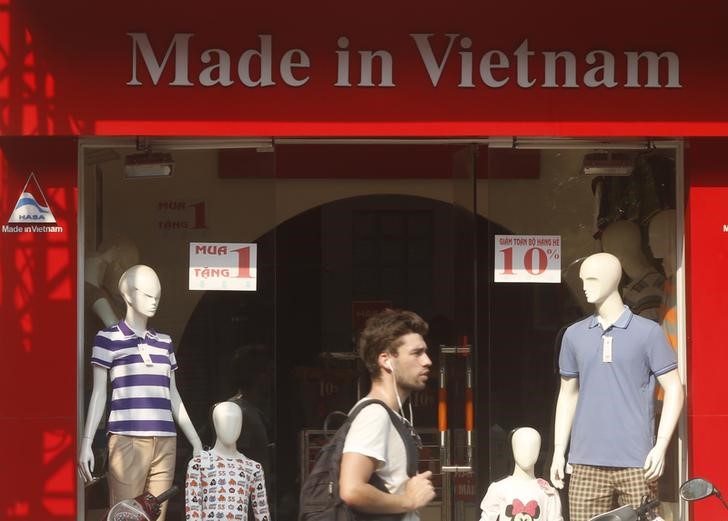
The U.S. launched a new Section 301 trade investigation into Vietnam’s intellectual property practices, potentially opening the door to additional tariffs on Vietnamese imports. The probe adds to two existing investigations into alleged excess manufacturing capacity and forced labor, with trade talks still unresolved. Vietnam’s trade surplus with the U.S. widened to $178.2 billion in 2025, up $54.7 billion from the prior year.
This is less about Vietnam alone and more about a broader escalation path in U.S. industrial policy: IP enforcement gives Washington a cleaner narrative for tariffs than pure deficit politics, which means the probability of action rises even if the eventual tariff rates stay modest. The market underappreciates how quickly this can propagate through multinational supply chains that have treated Vietnam as a China-plus-one hedge; even a 5-10% tariff shock can force re-pricing of sourcing assumptions, working capital, and margin guidance across apparel, footwear, electronics assembly, and consumer hardlines.
The first-order losers are importers with concentrated Vietnam exposure, but the second-order losers may be the “safe haven” reraters that benefited from diversion out of China. If Vietnam loses tariff preference, the next marginal winner is not necessarily the U.S. but Mexico, India, and potentially Thailand/Malaysia for assembly-intensive categories; that can compress valuation premiums for Vietnam-linked EM proxies while supporting nearshoring beneficiaries. The setup also increases the odds of transshipment scrutiny broadening beyond Vietnam, which would raise customs/friction costs across the region and slow inventory normalization.
The catalyst window is 1-3 months, not years: the July conclusion of the existing probes is the obvious inflection point, and any interim rhetoric can move import-sensitive equities before policy is finalized. A meaningful de-escalation would require a visible enforcement package from Hanoi plus a politically acceptable market-access concession for Washington; absent that, the path of least resistance is incremental tariff pressure rather than a clean resolution. Tail risk is a sharper-than-expected tariff stack that hits goods already rerouted from China, producing a near-term hit to U.S. retail gross margins and a temporary inflation impulse in low-to-mid ticket categories.
The contrarian angle is that the headline risk may be more actionable than the economic damage: the U.S. can use the threat of tariffs to extract concessions without fully detonating supply chains, which limits the upside for aggressive short positioning in broad retailers. The better trade is relative value around sourcing winners and losers, not a macro bet on EM Asia collapse.
AI-powered research, real-time alerts, and portfolio analytics for institutional investors.
Request DemoOverall Sentiment
mildly negative
Sentiment Score
-0.25
