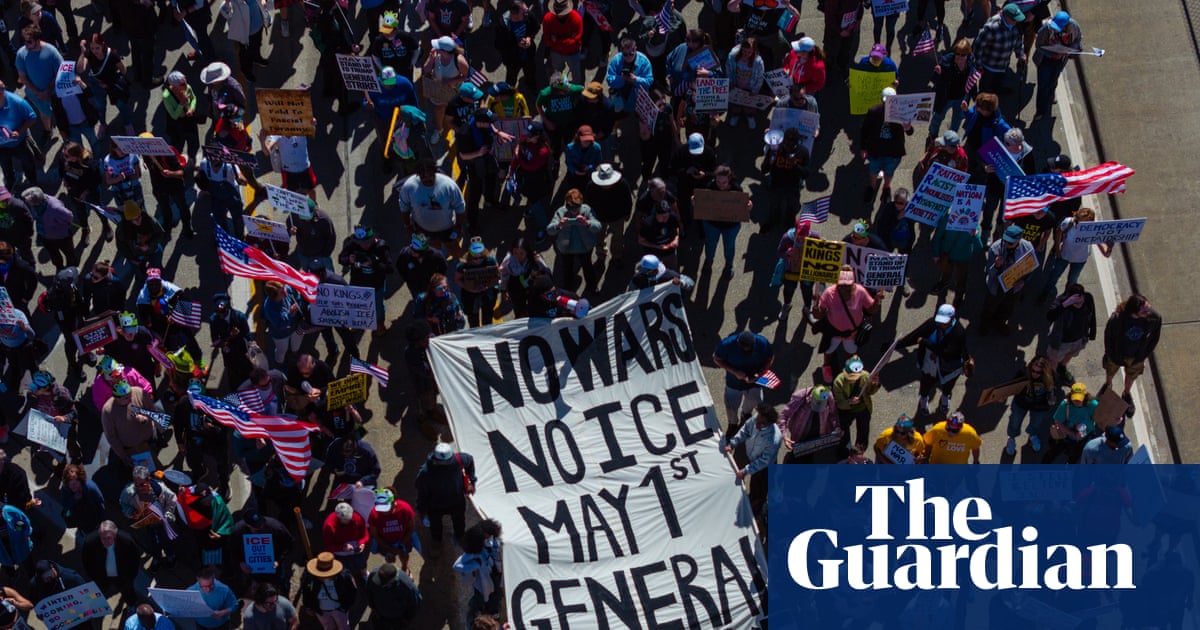
Thousands are expected to join 3,500 May Day economic blackout events nationwide on Friday, with organizers calling for "no school, no work, no shopping" and broader protests against ICE, war, and wealth concentration. The action is being framed as a "structure test" for the movement and as a step toward a future general strike, but the article does not cite any direct market, company, or macroeconomic data. Potential impact is limited to localized disruption and labor-political signaling rather than a clear market-moving event.
This is less a macro event than a coordination test for labor, activist, and education networks. The immediate market read-through is not broad GDP damage, but localized friction: logistics, retail traffic, staffing, and municipal services in select metros can be temporarily disrupted, which matters most for companies with high same-day revenue sensitivity and thin labor buffers. The bigger signal is that a repeatable protest architecture is forming; that increases the odds of more frequent, lower-grade disruptions rather than one-off headline shocks.
The second-order winners are the firms and sectors that can absorb absenteeism with automation or pricing power, while the losers are businesses reliant on in-person throughput and discretionary footfall. Think travel, restaurants, quick-service, urban retail, parcel delivery, and school-adjacent service providers in protest-heavy markets, though the effect should fade quickly unless participation broadens materially. In labor-sensitive sectors, the more important consequence is bargaining leverage: management teams may face a higher floor on wages, scheduling flexibility, and safety commitments even if the protest itself is brief.
The real catalyst risk is escalation from symbolic non-cooperation to something closer to organized work stoppage coordination. That is a multi-quarter process, not a Friday event, but if unions begin synchronizing contract expiries toward 2028, investors should treat it as a rising wage-cost regime and a higher strike-probability environment for transport, manufacturing, and public-facing service names. Conversely, if turnout disappoints or the event remains highly fragmented, the market will likely fade this as political theater and refocus on fundamentals within days.
The contrarian angle is that consensus may be underpricing the institutional learning curve, not the headline disruption. Even failed blackouts can improve organizer playbooks, data on participation, and future targeting of critical nodes; that creates an option value for activists that markets usually ignore until it shows up in earnings calls. For now, the trade is not about a broad market short, but about selective exposure to labor-fragile business models and event-driven volatility around high-footfall consumer names.
AI-powered research, real-time alerts, and portfolio analytics for institutional investors.
Request DemoOverall Sentiment
neutral
Sentiment Score
0.00
