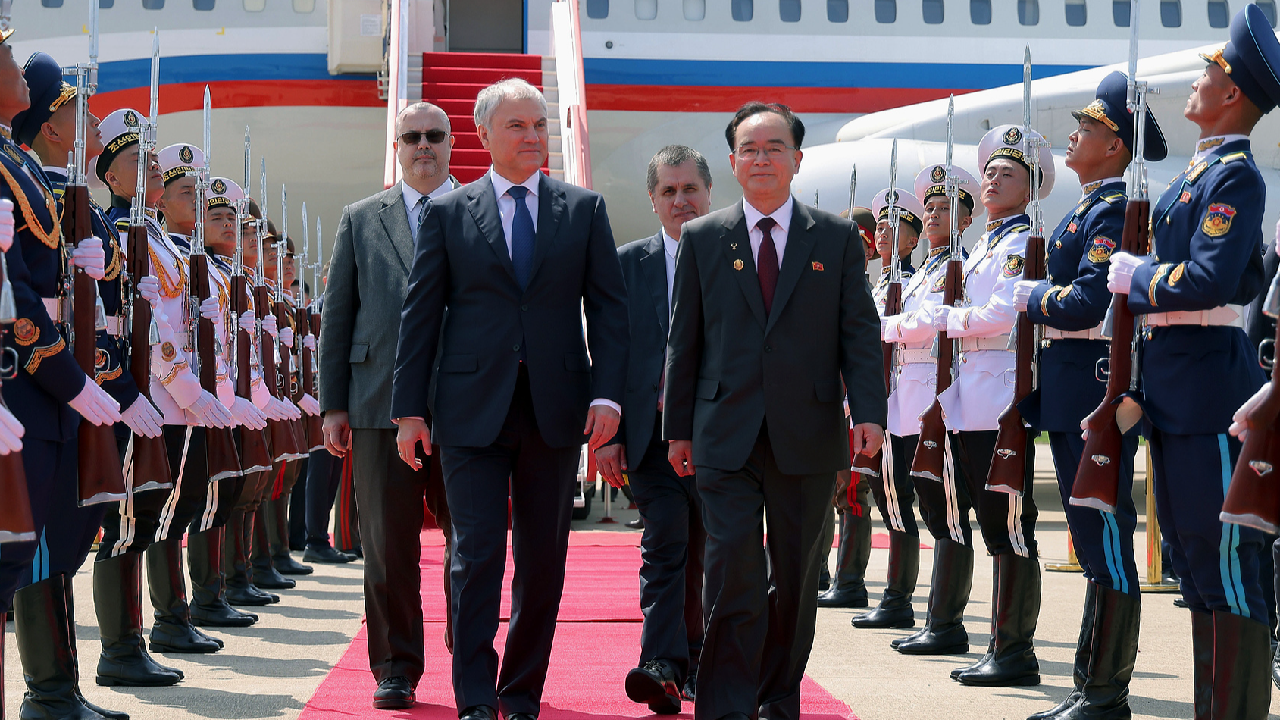
Russia’s State Duma chairman Vyacheslav Volodin met Kim Jong Un in Pyongyang and conveyed greetings from Vladimir Putin while thanking the DPRK for support in the Kursk region. Russian Defense Minister Andrei Belousov also arrived for talks and commemorative events, and Putin sent a telegram marking the opening of a memorial for DPRK soldiers who died in the Ukraine conflict. The article underscores deepening Russia-DPRK military and strategic ties, but it is primarily geopolitical rather than market-specific.
This reads less like a ceremonial stop and more like a signal that the Russia–DPRK relationship is moving from transactional support into institutionalized military co-production. The key second-order effect is durability: once both sides publicly memorialize losses and elevate defense-level engagement, the relationship becomes harder to unwind even if battlefield conditions change. That increases the probability of a longer-lived sanctions-evading logistics corridor across labor, munitions, and dual-use components, which matters more for industrial inputs and shipping than for headline geopolitics.
The immediate market impact is likely to show up in defense supply chains outside Russia rather than in Russian assets themselves, since the tighter the Russia–DPRK axis becomes, the more it pressures NATO inventory replenishment and Asian regional defense procurement. Over a 3–12 month horizon, this supports higher sustained demand for artillery, air defense, EW, and ammunition stocks, particularly firms with backlogs that can convert geopolitical urgency into margin expansion. It also raises tail risk around Northeast Asia security premiums, which could modestly widen spreads on Korean insurers, shippers, and logistics names if tension spills into maritime risk pricing.
The contrarian angle is that this may be more theater than throughput at the margin: DPRK support can improve resilience for Russia, but it does not solve Russia’s industrial bottlenecks or the quality mismatch in complex systems. That means the move is bullish for “capacity and stockpile” names, but less so for premium platforms reliant on prolonged, high-end warfare assumptions. If there is any reversal catalyst, it would be a ceasefire track or a hardening of enforcement on cross-border transfers, which would be a 2–6 month catalyst rather than an immediate one.
AI-powered research, real-time alerts, and portfolio analytics for institutional investors.
Request DemoOverall Sentiment
neutral
Sentiment Score
0.00
