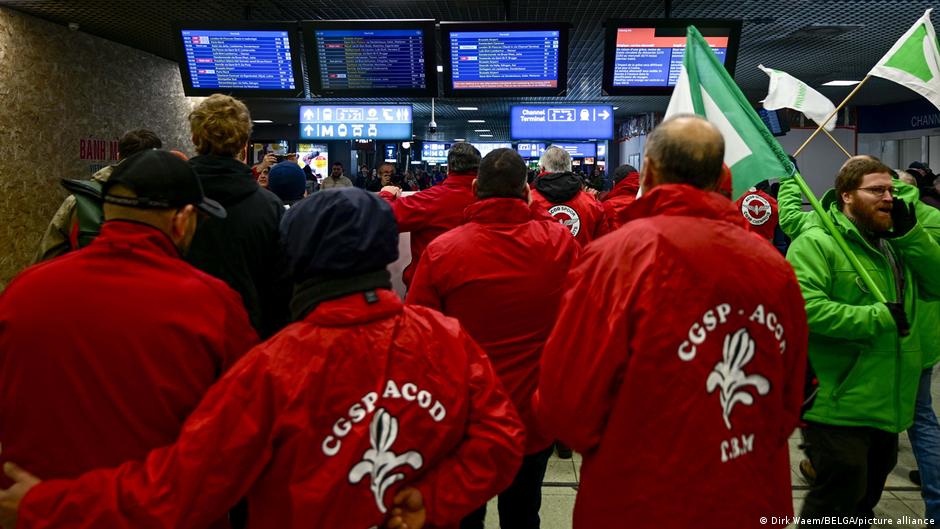
Belgium has launched a three-day nationwide strike against Prime Minister Bart de Wever's five-party coalition after a multiyear budget deal that includes €9.2bn in savings by 2029 and a stated need to cut about €10bn by 2030 to meet EU fiscal rules. The industrial action — which will escalate from reduced rail services and canceled ICE trains to hospital staff, teachers and a Wednesday general strike involving private-sector unions — is expected to severely disrupt rail, local transport and both Brussels-Zaventem and Charleroi airports (no departures expected Wednesday), with spillovers into cross‑border traffic to Germany. The stoppages raise near-term downside risk to domestic economic activity, transport and travel-related revenue and add political uncertainty around fiscal reform and rising defense spending obligations tied to NATO commitments.
Market structure will shift short-term consumption and mobility demand away from rail/airport incumbents toward flexible road and low-cost air capacity; expect 5–15% revenue hit over 1–2 weeks for hub-dependent airport/rail operators and a modest reallocation of seat-mile demand to carriers with spare short-haul capacity. Competitive dynamics favor asset-light low-cost carriers and diversified logistics providers that can re-route freight, while domestically exposed banks and insurers face margin compression if sovereign spreads move 10–40bp. Cross-asset signals: anticipate a pick-up in EUR volatility, airline/airport equity IV +30–80% intraday, and a directional rise in Belgium 10y sovereign spreads relative to Bunds.
Tail risks include escalation to protracted industrial action or coalition collapse producing a 50–100bp sovereign spread shock and rating action; operational tail risks include blockade of freight corridors causing manufacturing disruptions across Benelux auto/chem supply chains. Time horizons: immediate (days) = revenue/earnings misses for travel, short-term (1–3 months) = credit spread and volatility normalization trades, long-term (6–24 months) = fiscal negotiation outcomes that re-price Belgian sovereign and bank fundamentals. Hidden dependencies: logistics providers with hub concentration in Belgium (ports/rail terminals) are second-order exposures to domestic politics.
Trading implications: tactically long liquid low-cost airlines and option volatility on names with hub exposure, short selective Belgian financials/airport equities and buy sovereign-credit protection sized to portfolio duration (0.5–1% DV01). Use 1–3 month expiries for tactical option plays and 6–12 month credit protection to hedge politically driven spread risk; rotate into logistics/warehousing leaders if strikes normalize. Entry window: Deploy within 1 week for tactical trades; scale out over 4–12 weeks as headlines and spreads settle.
Contrarian view: consensus may overestimate permanent demand destruction—if the coalition survives and implements consolidation, Belgian credit could tighten 20–40bp over 6–12 months, creating a mean-reversion opportunity in beaten-up BEL-linked equities. The market may temporarily overprice CDS/vol; opportunistic long-call spreads on fundamentally strong Belgian names (banks, AB InBev) after a >5% drop could capture rebound. Unintended consequence: aggressive shorting of Belgian credit could be self-defeating if ECB/European backstops intervene, capping spreads.
AI-powered research, real-time alerts, and portfolio analytics for institutional investors.
Request DemoOverall Sentiment
moderately negative
Sentiment Score
-0.30
