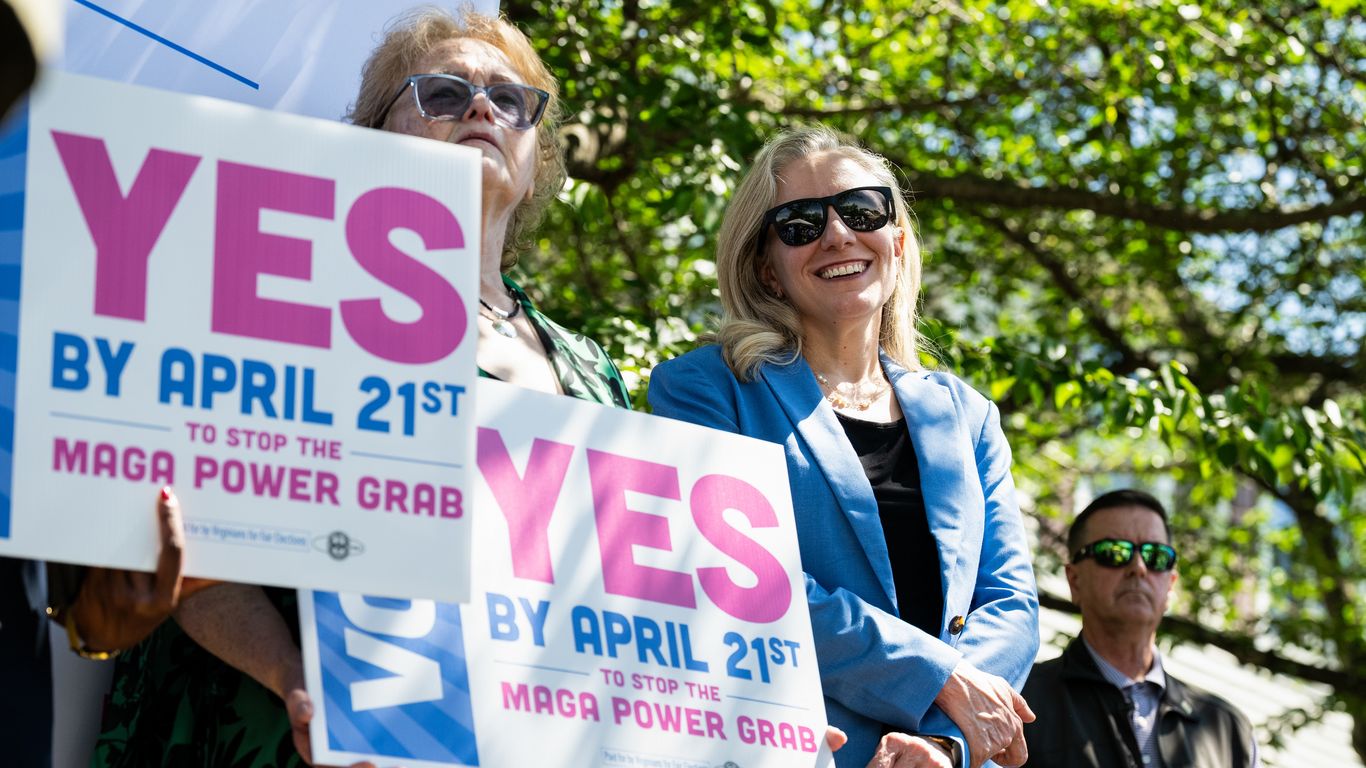
Virginia voters narrowly approved a congressional map redrawn to favor Democrats, potentially shifting the state's delegation from a 6–5 Democratic edge to roughly 10–1 and putting four Republican incumbents at risk. Republicans plan to appeal to the Virginia Supreme Court, while the broader redistricting battle continues in Florida, Texas, California, and other states. The article is primarily political and legislative in nature, with limited direct market impact.
The immediate market read is that this reduces the probability of a near-term GOP House seat expansion, but the bigger second-order effect is escalation risk: each successful redraw raises the odds of a tit-for-tat cycle in other states, which increases legal spend, political volatility, and the chance that House control remains highly path-dependent into 2026. That matters less for broad markets than for policy-sensitive sectors, because a tighter/less predictable House makes it harder to handicap tax, healthcare, telecom, and antitrust outcomes.
The more actionable insight is that the center of gravity is shifting from who wins one referendum to how much map churn the courts will tolerate. If appellate courts or state supreme courts start selectively blocking redraws, the winners are states with stronger procedural constraints and incumbents with entrenched district-level advantages; the losers are national committees and candidates running in newly constructed “paper” districts that may underperform once turnout normalizes. The timing is crucial: the current advantage is mostly a 3-12 month story into the next election cycle, while the legal overhang can extend 12-24 months and reprice expectations multiple times.
Contrarian view: the consensus is treating this as a clean Democratic win, but the narrow margin suggests the tactic may be less transferable than the national party hopes. If purple-state voters punish overtly partisan mapmaking, Democrats may gain a few seats in the short run but weaken the suburban coalition they need for broader control, which could cap the durability of the advantage. The asymmetric risk is that Republicans still get a partial offset in Florida or through courts, while Democrats absorb the reputational cost of normalizing the very behavior they have criticized, leaving the net seat impact smaller than headline rhetoric implies.
AI-powered research, real-time alerts, and portfolio analytics for institutional investors.
Request TrialOverall Sentiment
neutral
Sentiment Score
-0.05
