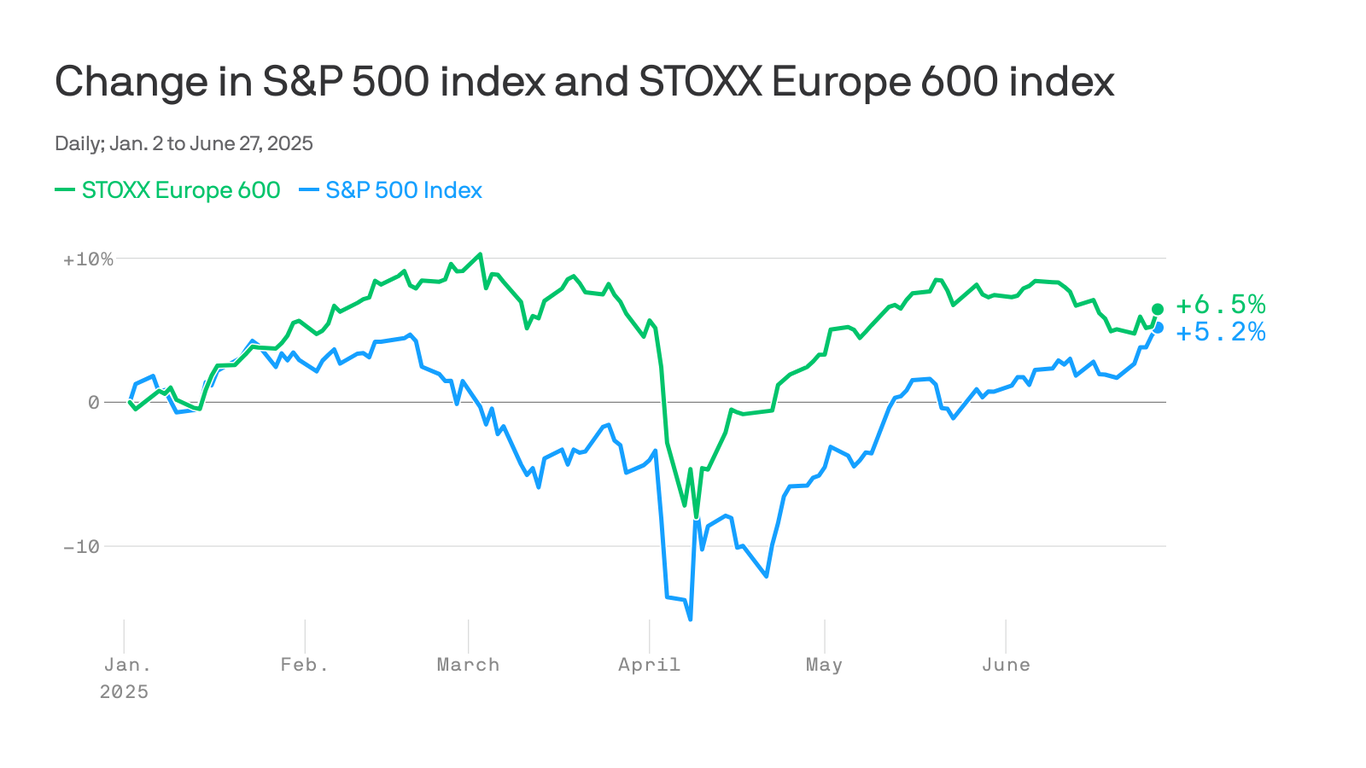
While the U.S. stock market reaches new highs, its year-to-date gains of 5% in the S&P 500 are significantly outpaced by international indices, such as the German DAX (20%) and Chinese Hang Seng (24%), prompting some strategists to advocate a 'Sell America' trade due to U.S. policy volatility and aggressive foreign fiscal stimulus. However, despite this broader macro perspective, investor bullishness on U.S. equities remains strong, largely driven by large-cap technology stocks which account for half of the S&P's gains and continue to push the index to new records, indicating that tech-specific strength is currently overriding concerns about broader U.S. market fundamentals.
A significant divergence is evident between U.S. and international equity market performance, despite the S&P 500 reaching record highs. The S&P 500's 5% year-to-date gain is substantially overshadowed by returns from foreign indices such as the German DAX (+20%) and the Chinese Hang Seng (+24%), signaling strong investor appetite for non-U.S. assets. This rotation is underpinned by a "Sell America" thesis, which cites U.S. policy volatility and the country's diminishing role as a traditional safe haven. Strategists point to aggressive fiscal stimulus in Europe and other regions as a key driver for superior earnings growth outlooks abroad. However, the U.S. market's resilience is not broad-based; it is highly concentrated in large-cap technology stocks, which are credited with driving about half of the S&P 500's gains. This suggests that current U.S. market strength is less a reflection of the overall domestic economy and more a specific belief in the continued outperformance of the tech sector, which is expected to be further supported by a weaker U.S. dollar.
AI-powered research, real-time alerts, and portfolio analytics for institutional investors.
Overall Sentiment
mixed
Sentiment Score
0.00
Ticker Sentiment
