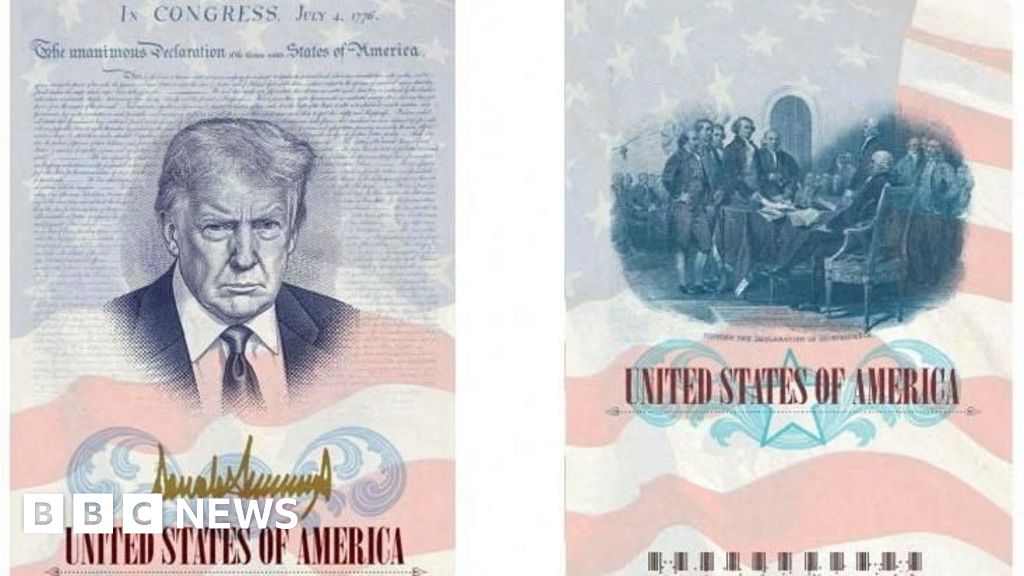
The White House confirmed that a limited number of commemorative US passports featuring President Trump will be issued as part of the July 250th anniversary celebrations for the Declaration of Independence. The rollout will be available only through the Washington Passport Agency and only while supplies last, with no clarity yet on whether citizens can opt out. The move fits a broader pattern of branding government programs and public assets with Trump’s name and likeness, but it is largely symbolic and unlikely to have meaningful market impact.
This is less a tourism-side novelty than a signaling event: the administration is using low-cost, high-frequency government touchpoints to normalize a personal brand across civic infrastructure. The immediate economic impact is trivial, but the market-relevant read-through is that federal agencies will likely keep prioritizing symbolic rollouts over procedural friction, which raises the odds of more headline-driven, legally contested announcements into the election cycle and semiquincentennial window.
The second-order winner is the ecosystem that monetizes patriotic spectacle rather than the government printer itself: broadcast, event production, security, and vendors tied to Washington DC foot traffic could see incremental demand spikes around each staged unveiling. The loser is the pool of institutions that depend on stable apolitical administration — heritage groups, museum-adjacent operators, and concessionaires exposed to disruption risk if protests, litigation, or permitting delays intensify around these launches.
The real catalyst path is legal, not commercial. If courts or agencies force delays, the story flips from brand reinforcement to governance overreach, and the reputational downside compounds because each successive commemoration becomes a test of institutional resistance. Conversely, if rollout proceeds smoothly, the market should expect more of the same: a steady drumbeat of identity-linked federal announcements that keeps media attention elevated but fades quickly unless paired with actual policy transfer to private beneficiaries.
Contrarian take: this is probably over-interpreted as an equity signal in the near term, but underpriced as a volatility source. The important trade is not on the passport itself; it is on the probability distribution of incremental legal and civic conflict created by repeated personalization of public assets, which can create short-lived dislocations in media, defense/security, and DC-adjacent real estate names.
AI-powered research, real-time alerts, and portfolio analytics for institutional investors.
Request DemoOverall Sentiment
neutral
Sentiment Score
0.05
