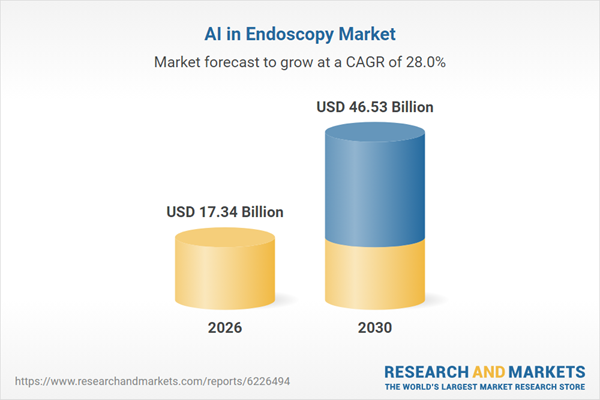
ResearchAndMarkets added an “AI in Endoscopy Market Report 2026” citing rapid expansion in the AI endoscopy market, rising from $13.52B in 2025 to $17.34B in 2026 (28% CAGR). This points to strong demand momentum for AI-enabled medical imaging and related tools, though it is primarily market-research information with limited immediate trading impact.
This is not a near-term earnings catalyst; it is a sign that AI in GI/endoscopy is becoming a budget line rather than a lab demo. The first money is likely to accrue to incumbents that can bundle software into installed hardware and service contracts, because the economics come from workflow lock-in and recurring attach, not from model quality alone. That argues for the public names with distribution into procedural suites, while standalone algorithm vendors face a harder path to monetization unless they can show measurable miss-rate reduction and reimbursement support.
The second-order effect is on utilization. Better lesion detection can raise short-term biopsy, pathology, and repeat-procedure volumes over the next 1-3 quarters, which is modestly supportive for large diagnostics platforms, while also strengthening case volume for ambulatory GI centers. Longer term, if screening becomes materially more effective, you could see less downstream oncology spend, but that is a 6-18 month-plus effect and depends on real-world adoption, not reportable market size.
Contrarian view: the market may be overpricing the AI label and underpricing the integration burden. In medtech, adoption usually stalls on liability, false positives, training time, and IT friction; if the technology adds even a few minutes per procedure or increases follow-up biopsies without clearly improving reimbursement, hospitals will slow purchase decisions. The key falsifier is not the report size but whether vendor commentary over the next two earnings cycles shows AI-driven attach rates, capex conversion, or procedure economics improving.
AI-powered research, real-time alerts, and portfolio analytics for institutional investors.
Overall Sentiment
mildly positive
Sentiment Score
0.15
