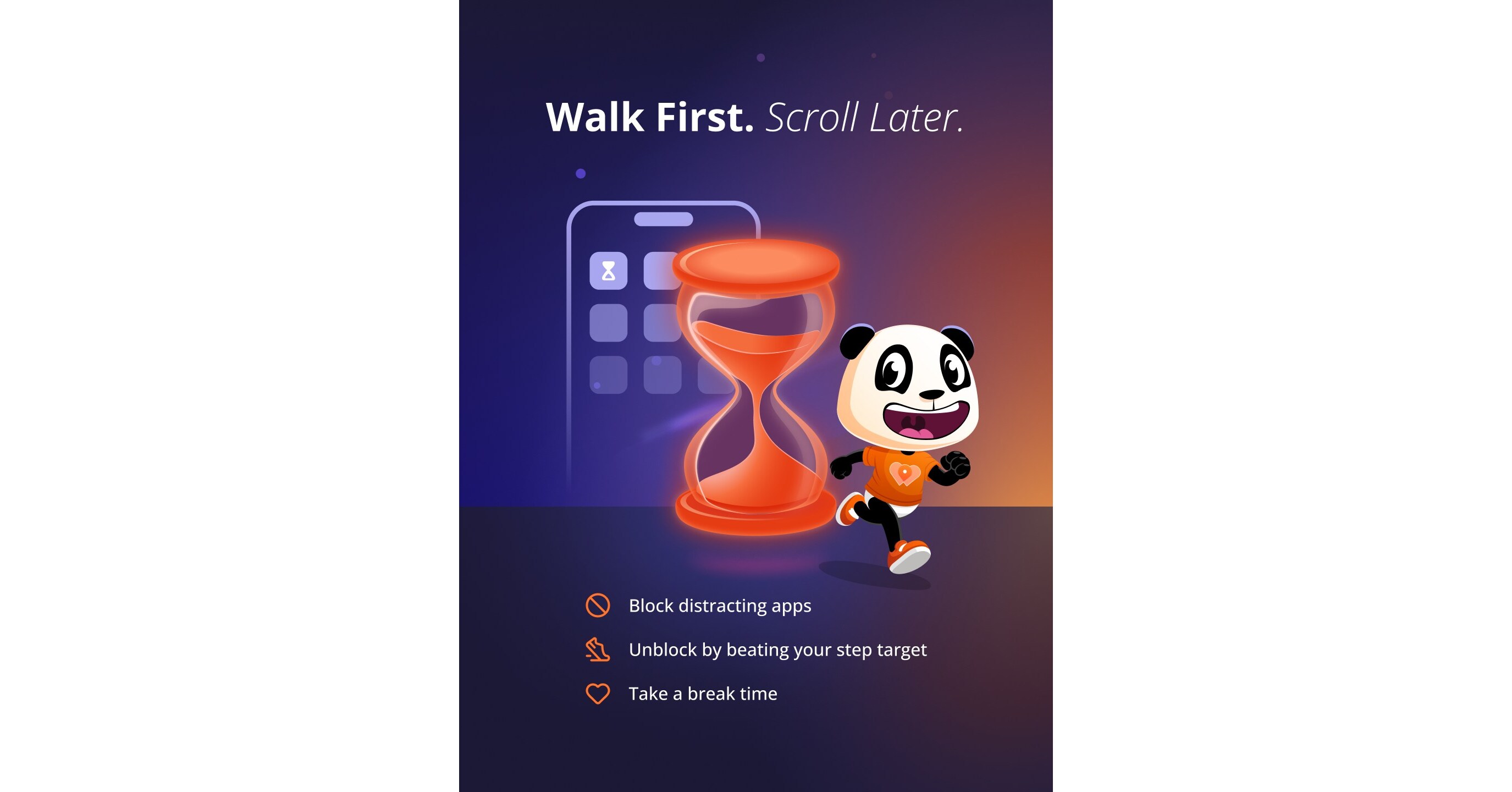
WeWard launched its “Walking Mode” feature on July 8, 2026, letting users restrict selected apps (notably social media/games/streaming) until they hit a personalized daily step goal (e.g., 3,000–7,000+ steps). The company cites that the app increases users’ walking time by an average of ~25% and reports users spend only a few minutes per day in-app while still maintaining record growth and engagement. The feature rolls out to all 30M users across 29 countries.
This is more a behavioral product signal than a near-term earnings catalyst. The economically relevant read-through is that attention can now be intentionally throttled by the same devices that monetize it, which is a modest long-term headwind for ad- and session-time-driven platforms if the feature gets copied at the OS level. For now, the market impact is likely negligible: voluntary adoption tends to be high in press cycles and low in steady state, so the first-order revenue drag on META/SNAP/ROKU/NFLX is likely de minimis unless usage data shows sustained substitution.
The more interesting second-order effect is competitive. If this concept gains traction, Apple and Google are the natural gatekeepers because they control cross-app permissions, notifications, and wellness dashboards; they can absorb the feature into the OS and commoditize smaller wellness apps. That would be bullish for platform stickiness and bearish for standalone "digital wellbeing" apps without proprietary distribution. On the benefit side, wearables and health-data ecosystems could see incremental engagement if step counting becomes a gating mechanism for other behavior, but that only matters if it converts into paid hardware or subscription attach.
Near term, the key risk is novelty decay: users may try it for a week, then disable it once it becomes friction. Over 1-3 months, watch whether competitors emulate it and whether app-store rankings or cohort retention improve. Over 6-18 months, the structural risk to attention-based monetization rises only if schools, parents, or regulators endorse similar "wellness by default" controls. The thesis is falsified if there is no measurable uptake or if users revert quickly, which would leave this as a PR-friendly feature with little economic leakage.
AI-powered research, real-time alerts, and portfolio analytics for institutional investors.
Request DemoOverall Sentiment
mildly positive
Sentiment Score
0.20
Ticker Sentiment
