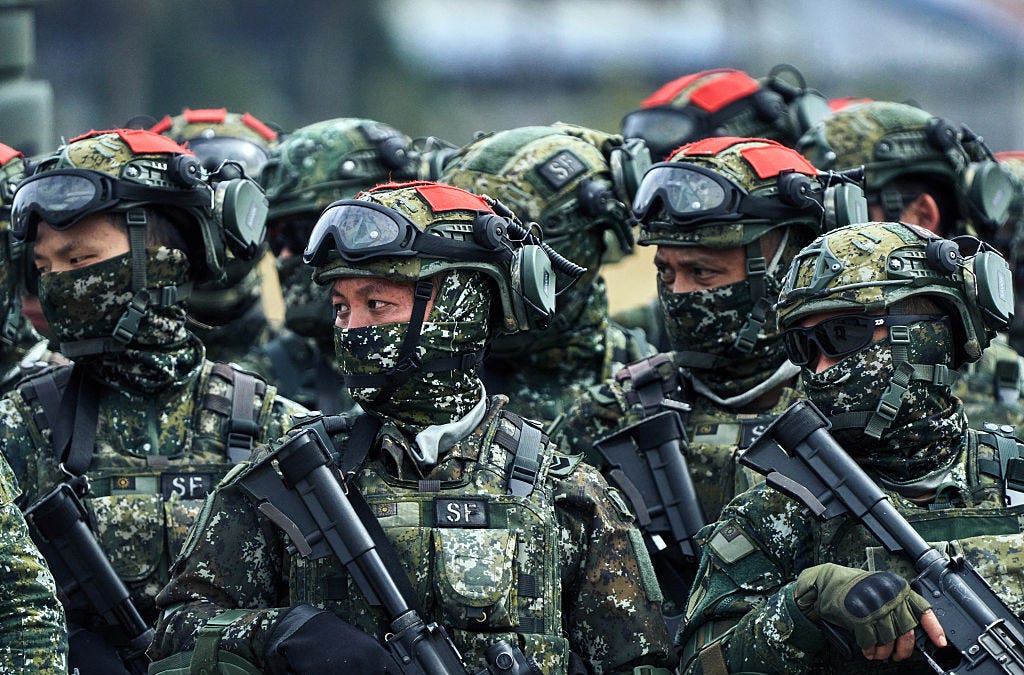
Taiwan remains a major flashpoint ahead of the Trump-Xi summit, with the PLA's December 'Justice Mission 2025' drill simulating a maritime blockade of the Taiwan Strait and key ports. The article highlights rising invasion risk, an unapproved $11 billion U.S. arms deal with Taiwan, and broader U.S.-China strategic tension. While no immediate market data is reported, the geopolitical backdrop is significant enough to affect defense and risk sentiment across markets.
The market is underpricing how quickly Taiwan risk can migrate from a geopolitical headline to a capital-markets constraint. The key second-order effect is not an immediate invasion probability spike, but a rerating of U.S. and allied defense supply chains, undersea communications, satellite resilience, and Japanese/Korean industrial policy as buyers start paying for deterrence capacity rather than just end-product weapons. That tends to favor firms with long-dated backlogs and software/command-and-control exposure over pure platform names, because procurement priorities typically shift toward sensing, missiles, EW, ISR, and logistics before any full-force amphibious scenario becomes relevant.
The biggest near-term catalyst is not the summit itself but the signaling bandwidth around it: any language suggesting Congress delay or soften Taiwan-related approvals, or any PLA exercise that looks like a blockade rehearsal rather than a show of force, would likely widen implied volatility across defense and semicap supply chains. Over months, the more material risk is cumulative: shipbuilding bottlenecks, missile inventory depletion, and allied stockpiling can create capacity shortages that reward domestic producers with political protection and pricing power. That should also bleed into industrial metals and specialty electronics as procurement shifts toward higher unit intensity per dollar of deterrence.
Contrarian angle: consensus tends to focus on invasion odds, but the more investable regime is persistent gray-zone coercion, which is cheaper for China and more expensive for Taiwan/U.S. readiness budgets. If investors are waiting for a definitive escalation, they may miss the step-change in capex and replenishment demand that arrives first. The tradeable path is a slow grind higher in defense multiples and a widening spread versus cyclicals with Taiwan exposure, while the tail risk remains an abrupt headline-driven de-risking event with limited ability for policymakers to immediately reverse it.
AI-powered research, real-time alerts, and portfolio analytics for institutional investors.
Request DemoOverall Sentiment
mildly negative
Sentiment Score
-0.15
The main reversal case is a credible diplomatic thaw paired with visible de-escalation in PLA exercise tempo and concrete congressional movement on the arms package; absent that, the risk premium should persist for quarters, not days. In that environment, the asymmetry favors being long firms that monetize preparedness and short businesses whose margins depend on smooth cross-strait logistics or uninterrupted Asian electronics throughput.
