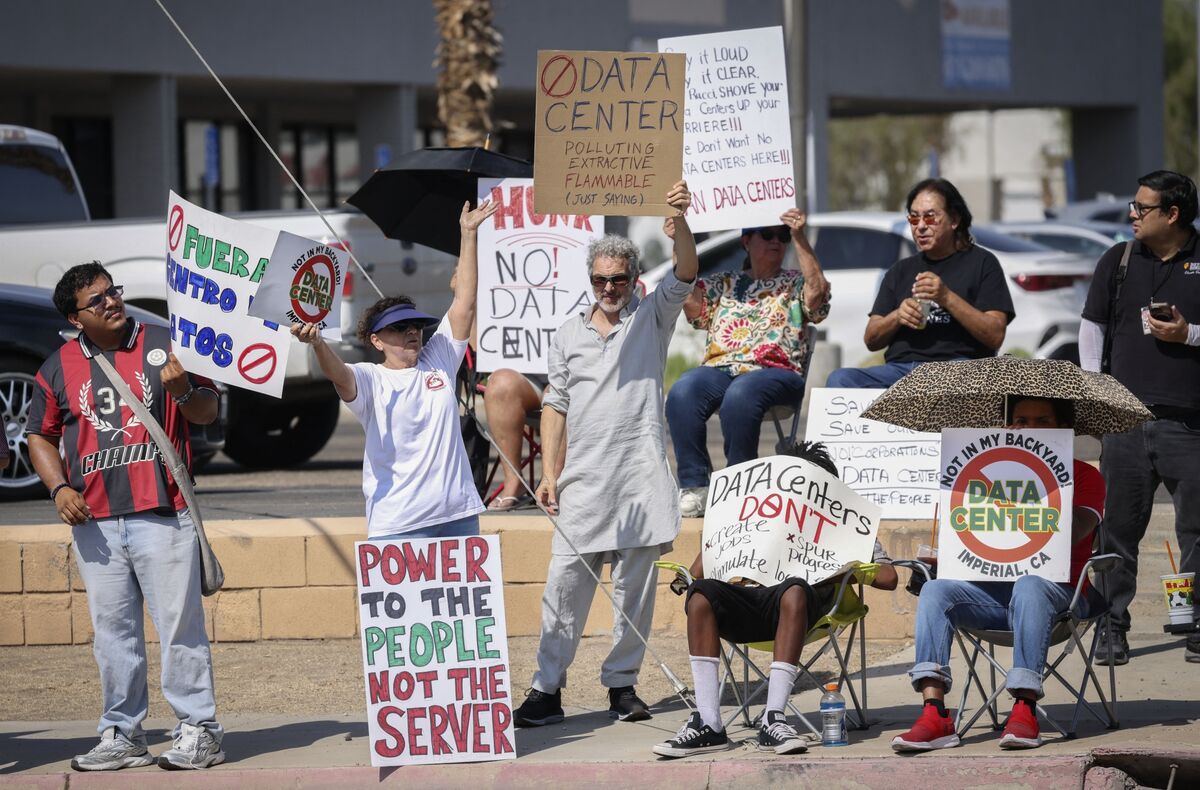
The article highlights growing public backlash against AI-driven data center development, arguing hyperscalers underestimated community opposition after a sharp shift from prior pro–data center tax incentives. It frames the pushback as centered on local impacts and the expectation that future developers will need to earn public acceptance. While no specific financial figures are provided, the narrative implies a potential headwind to AI infrastructure expansion from regulatory and community resistance.
The market is likely underestimating how quickly a local permitting fight can turn into a balance-sheet issue for hyperscalers. Once AI infrastructure is framed as a water/power/land problem rather than a software race, the marginal dollar of capex gets less elastic: more legal expense, longer site timelines, and higher community-offset costs all push out payback periods. That is most relevant for GOOGL, where AI monetization depends on continuing to scale training and inference capacity without interruption.
The first-order losers are the companies that need fresh physical capacity now; the second-order winners are the incumbents with already-entitled footprints and leaseable space. Colocation and data-center REITs such as EQIX and DLR gain scarcity value if new greenfield builds become politically harder, while power-grid and water-related vendors could see a mixed effect: more spending on infrastructure, but slower net megawatt additions. AAPL is less directly exposed, but any broad AI infrastructure slowdown weakens the narrative that on-device/cloud AI upgrades will ramp smoothly across the ecosystem.
The key catalyst path is not earnings but permitting cadence over the next 1-3 quarters: if approvals slow, developers will have to either pay up for friendlier jurisdictions or accept lower utilization on near-term GPU deployments. Over 6-18 months, that can compress returns on AI capex and shift multiple leadership away from the most capital-intensive hyperscalers toward asset-light software and scarcity assets. The contrarian risk is that the backlash is real but not binding: large platforms can pivot to brownfield sites, rural power hubs, and lease capacity rather than own it, limiting the damage.
What would falsify the thesis is evidence that hyperscaler capex and megawatt delivery remain on schedule despite the noise, or that state-level incentives override local opposition fast enough to preserve build pace. If that happens, the market should fade the headline and keep the multiple premium on GOOGL intact. If not, the signal is a structural increase in cost of growth, not a temporary sentiment hit.
AI-powered research, real-time alerts, and portfolio analytics for institutional investors.
Request DemoOverall Sentiment
mildly negative
Sentiment Score
-0.25
Ticker Sentiment
