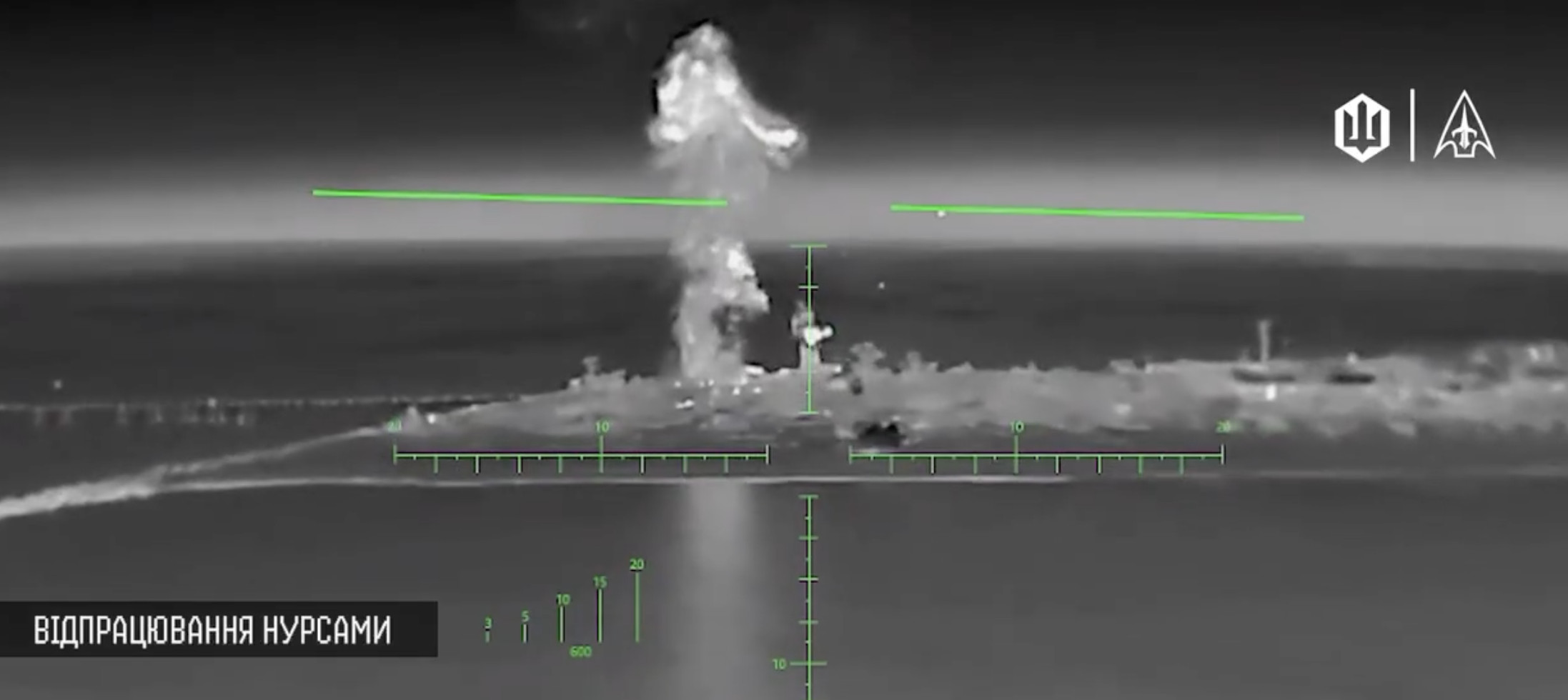
Ukraine’s Unmanned Systems Forces said it conducted a 48-hour air offensive that struck 46 Russian military and naval assets with 186 individual fire impacts. Targets included a border patrol ship in Dagestan, a Tor-M2 air defense system in Luhansk, a Black Sea Fleet communications hub in Crimea, and logistics assets in Donetsk, Zaporizhzhia, and Berdyansk. The operation underscores Ukraine’s long-range sanctions campaign and adds to geopolitical risk around the war and regional infrastructure.
This is less about battlefield optics and more about the compounding cost of operational uncertainty for Russia’s rear-area logistics. Sustained drone pressure on command nodes, air defenses, telecoms, and port/fuel handling assets raises the probability of localized “system failures” where relatively small physical damage creates outsized throughput loss. The key second-order effect is not just destruction of hardware, but the forcing function on Russia’s inventory mix: more mobile air defenses, more redundancy, more convoy dispersion, and more manual routing, all of which reduce effective warfighting capacity over the next several months.
The asymmetry matters because the marginal Ukrainian drone sortie is likely far cheaper than the replacement cycle for the assets being stressed, especially in air defense and communications. That creates a widening cost-exchange gap that can persist if Ukraine can sustain sortie generation and target selection discipline. The larger strategic implication is that Russia may be pushed into a defensive crouch around logistics corridors, increasing transport times and inventory buffers, which are classic drains on tempo and fuel efficiency.
The market read-through is mildly constructive for Western defense and drone-enabling supply chains, but the move is probably underappreciated in the industrials/logistics complex adjacent to the theater. Systems tied to secure communications, EW, drone components, batteries, precision sensors, and battlefield networking should see continued demand regardless of any headline ceasefire noise. The contrarian risk is escalation bias: if Moscow responds with a broader interdiction campaign or asymmetric retaliation, near-term headlines could whipsaw sentiment even if the underlying attritional trend remains intact.
AI-powered research, real-time alerts, and portfolio analytics for institutional investors.
Request DemoOverall Sentiment
mildly positive
Sentiment Score
0.20
