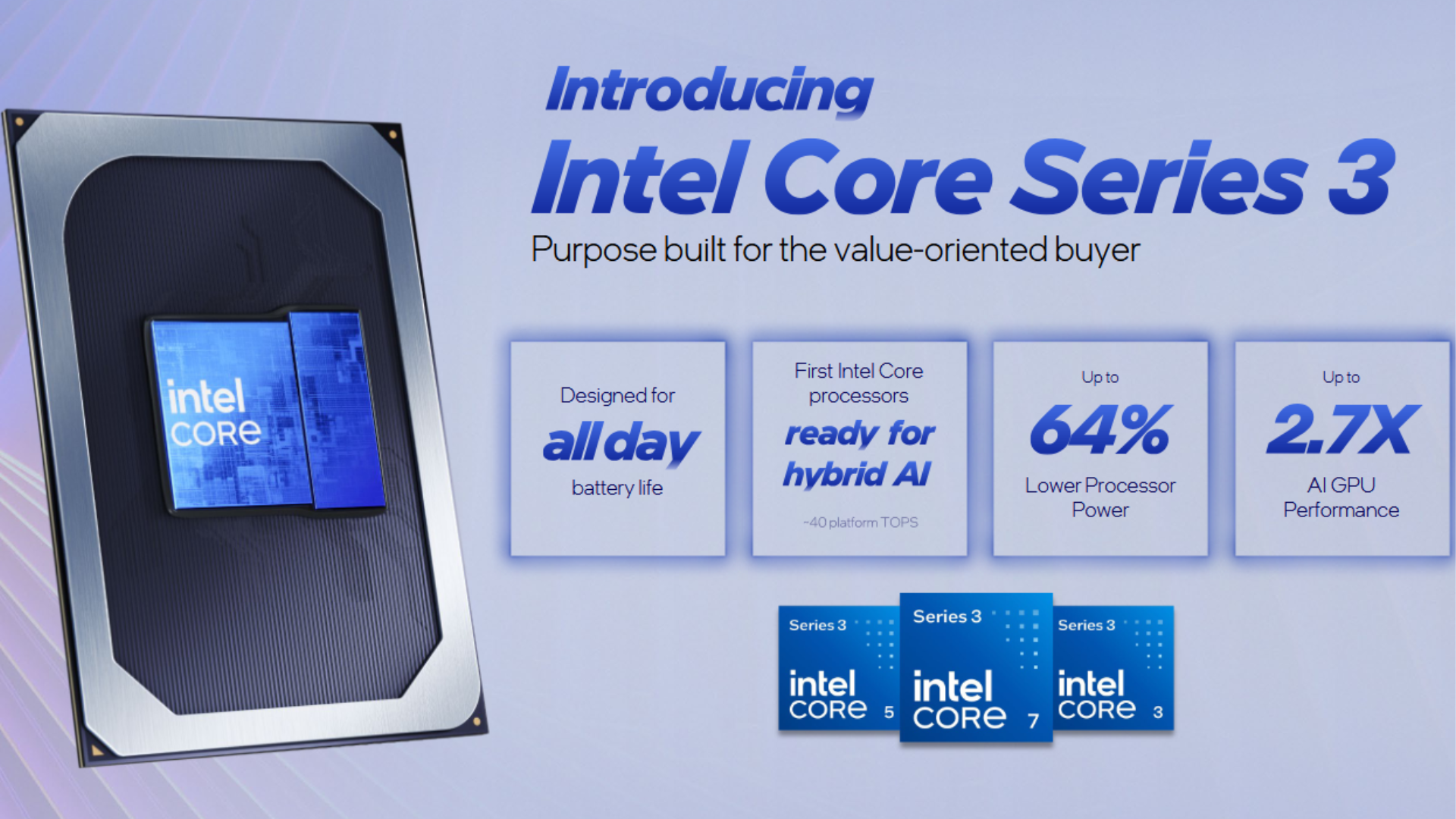
Intel's first Wildcat Lake laptop reference design has surfaced, highlighting a new low-end CPU lineup with up to 2 Cougar Cove P-cores, 4 Darkmont E-cores, 17 TOPS NPU capability, and power modes up to 35W PL2. The machine reportedly includes an aluminum chassis, 16 GB of RAM, and an 11W fanless mode, positioning it as a Windows-side competitor to Apple's MacBook Neo. This is an early product reveal rather than a commercial launch, so the likely market impact is limited.
Intel’s more important signal here is not the laptop itself, but that management is willing to spend process and validation effort on a low-end client platform with a meaningful sustained-power envelope. That implies Intel is trying to defend the sub-$700 Windows notebook tier where OEM attach rates matter more than absolute benchmark wins; if Wildcat Lake works, it improves socket share at the exact part of the market where Windows converts are most price-sensitive and where Apple’s hardware/software lock-in is weakest. The second-order effect is on ODMs and component suppliers: a fanless-or-nearly-fanless x86 design with decent sustained power can reduce system BOM complexity versus more fragmented fan-cooled low-end SKUs, supporting volume even if ASPs stay compressed.
The competitive read-through is mixed. Intel is clearly aiming to narrow the qualitative gap versus Apple’s low-power laptops, but the real bar is not peak performance—it is sustained performance per watt under light-to-moderate workloads, where Apple still owns the user-perceived experience. If Intel needs 11W fanless or 17–35W fan-assisted modes to stay competitive, it suggests the platform may be viable in larger, thermally forgiving chassis, but less compelling in premium-thin designs where OEMs increasingly want one SKU that can scale from passive to active cooling. That matters because the winners in client are the vendors that can spread one architecture across multiple tiers with minimal tuning cost.
The near-term catalyst is not consumer demand; it is OEM design-in momentum over the next 1–2 quarters. If major notebook brands adopt Wildcat Lake broadly, it helps Intel’s volume and improves utilization assumptions, but any delay would reinforce the narrative that Intel’s low-end roadmap is still catching up to competitors on efficiency. The main downside risk is that a low-end launch with modest NPU capability fails to stimulate premium replacement cycles, leaving Intel competing mostly on price and ceding margin to AMD in value notebooks while Apple retains the high-end halo.
The contrarian angle is that the market may be underestimating how important "good enough" x86 is in an AI-saturated PC refresh cycle. Most buyers will not pay for top-end NPU throughput; they will pay for battery life, quiet operation, and enough memory headroom to keep browsers, conferencing, and local AI helpers responsive. If Intel can deliver that at scale, the upside is not a halo product—it is a share-defense tool that can stabilize client revenue and reduce the chance of further unit erosion in 2026.
AI-powered research, real-time alerts, and portfolio analytics for institutional investors.
Request TrialOverall Sentiment
mildly positive
Sentiment Score
0.15
Ticker Sentiment
