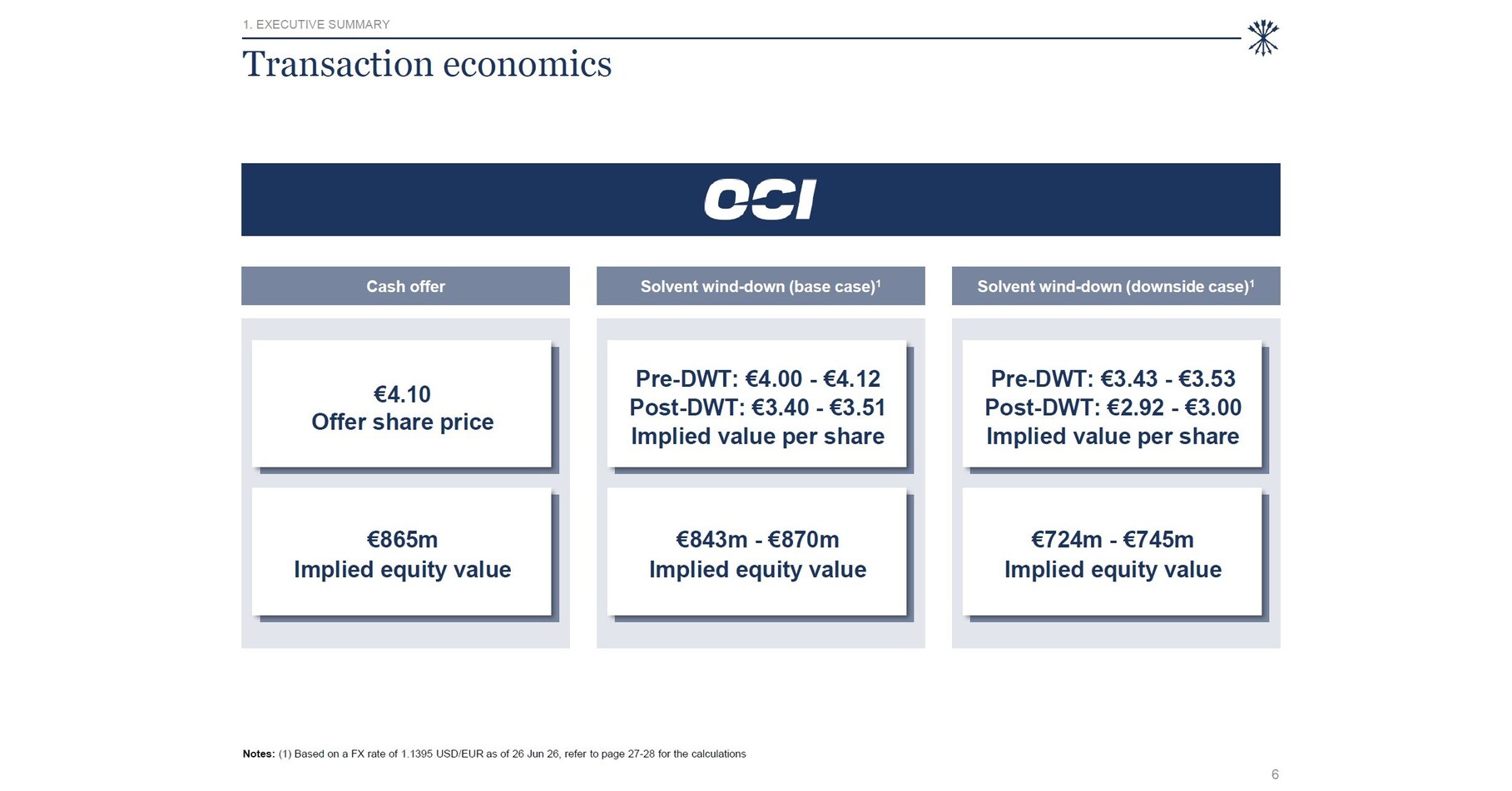
OCI’s board (excluding Nassef and Nadia Sawiris) recommends NNS’s voluntary all-cash offer at EUR 4.10 per OCI share (cum dividend), a 9% premium to the 6/24 close (€3.76) and an 11% premium to the 30-day VWAP (€3.71). Court-appointed independent directors consent to an EGM to approve the OCI–Orascom transaction, conditioned on NNS making, declaring unconditional, and settling the offer. The offer is deemed “fair” by advisors, but the court-appointed directors say it is not sufficiently convincing to recommend tendering; they still support the offer as cash optionality, while a solvent wind-down is expected to extend to at least 2031 and likely suffer a 15% Dutch dividend withholding tax hit.
This is a classic control-premium cleanup with a second-stage optionality wrapper. The immediate market mechanism is not earnings but governance: the cash bid sets a de facto floor, while the remaining equity optionality sits in whether minority holders can still capture the higher-value path without tax leakage. The board’s endorsement lowers the left-tail, but the real spread driver is execution risk around approvals, unconditionality, and whether the “combined” structure survives intact.
The key second-order effect is that the cash offer may neutralize the main source of discount in the stock: minority oppression risk. If that discount compresses, the stock should trade closer to offer value; if the market instead starts valuing the residual Orascom path as the true end-state, upside is capped by timing and withholding-tax friction, not headline price. For credit, the cleaner outcome is modestly positive because a solvent wind-down becomes less likely, but that is more about tail-risk reduction than a near-term rerating of creditors.
Catalyst path: over days, the spread should respond to offer-document filing and AFM process risk; over 1-3 months, the EGM and unconditional declaration matter more than the headline bid. Over 6-18 months, the real variable is whether the combined transaction closes without reopening the tax/liquidity problem; any delay pushes value back toward a discounted event-situation rather than a clean takeout. The contrarian view is that the market may be overfocusing on the €4.10 floor and underappreciating how much of the apparent upside to the higher Orascom outcome depends on a process that is still conditional and politically fragile.
There is no meaningful first-order read-through to C, JPM, MEOH, or TGT; this is a single-name special situation, not a broad macro or sector event.
AI-powered research, real-time alerts, and portfolio analytics for institutional investors.
Request DemoOverall Sentiment
neutral
Sentiment Score
0.05
Ticker Sentiment
