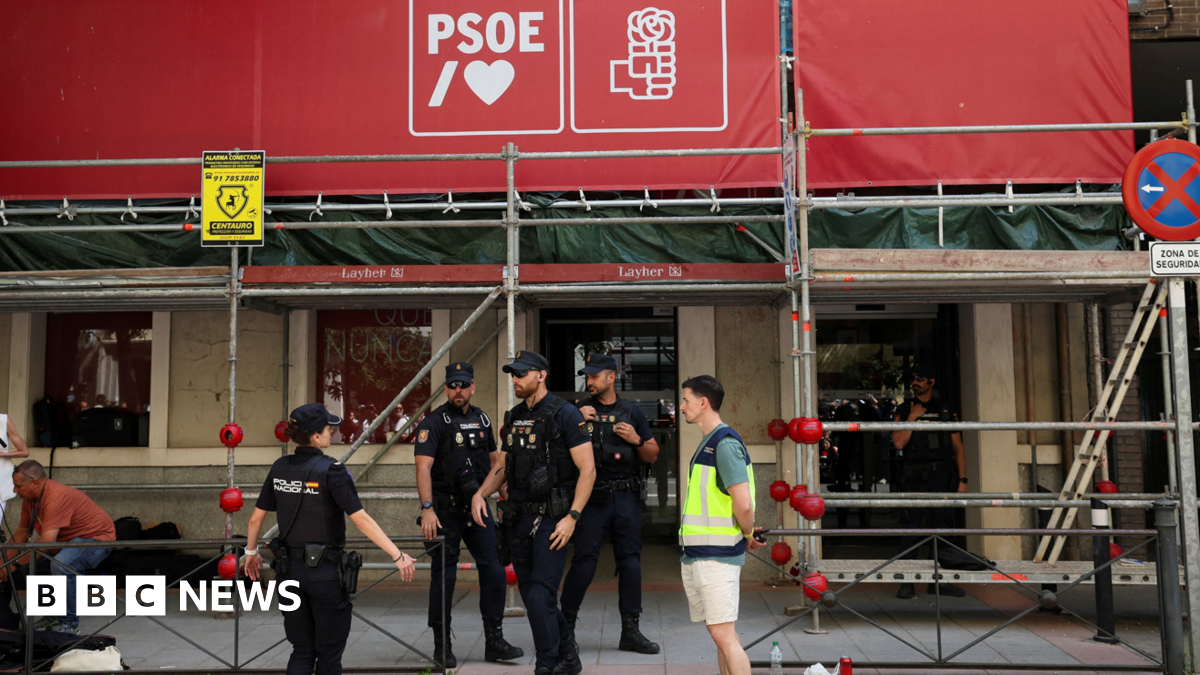
Spanish police raided the PSOE headquarters and seized documents amid an expanding corruption probe involving figures close to Prime Minister Pedro Sánchez, including former officials, his wife, and his brother. The latest developments add to political instability for Sánchez’s shaky minority coalition, while opposition leader Alberto Núñez Feijóo renewed calls for early elections. The article is legally and politically negative for Spanish governance, though the direct market impact is likely limited unless the scandal threatens policy continuity or elections.
This is not a one-off headline risk; it is a governance degradation trade that can persist for months because the market has to price both policy paralysis and coalition fragility. In Spain, that usually shows up first in domestic cyclicals and state-adjacent credits rather than in the broad index: procurement-dependent contractors, regulated utilities with political exposure, and banks with heavier sovereign beta can all underperform as investors demand a higher risk premium. The second-order effect is that even if the government survives, legislative throughput likely slows, which hurts capex visibility and delays any reform-driven rerating. The more interesting market implication is that the opposition does not need to win quickly for risk assets to weaken; it only needs to credibly force a prolonged election overhang. That tends to widen the gap between “Spain domestic” and “Spain export/global” businesses, because overseas revenue insulates margins from local policy noise while domestic discretionary and infrastructure names absorb the discount. If coalition partners begin to price a late-cycle breakup, Spain-specific financial conditions can tighten faster than macro data would justify. The contrarian angle is that headline severity may be peaking before market damage does. Corruption cases often generate a sharp initial repricing, but unless they trigger an immediate confidence crisis or snap election, the tape can stabilize as investors conclude the institutional response is functioning. The key catalyst to watch is whether coalition allies stop providing procedural support; that would convert reputational damage into a funding and budget-risk event within days, not months.
AI-powered research, real-time alerts, and portfolio analytics for institutional investors.
Request DemoOverall Sentiment
strongly negative
Sentiment Score
-0.65
