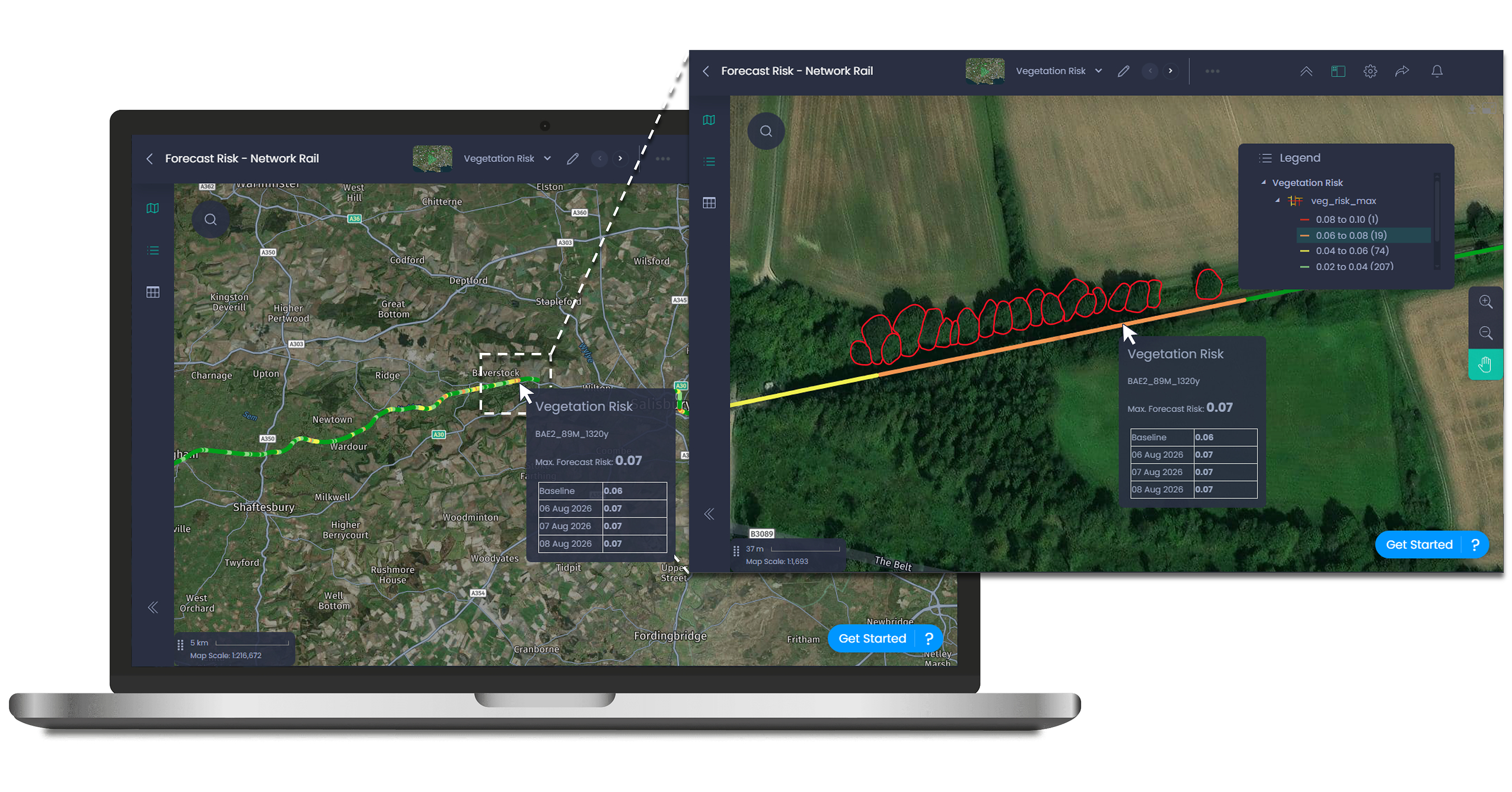
Network Rail and CATALYST completed a 12-week exploratory pilot using satellite imagery (including InSAR), vegetation modeling, and short-range weather forecasts to identify flooding and vegetation risks on the Wessex Route up to 3 days in advance. The prototype produced daily, traffic-light dashboard outputs and a two-layer framework separating baseline susceptibility from weather-driven risk amplification. Early user feedback was broadly consistent with known risk areas and suggested tree-fall risk insights could improve vegetation monitoring frequency versus the current ~3-year cadence, supporting more targeted inspections and fewer avoidable disruptions.
This is more important as a validation signal than as an immediate revenue event. The economic value sits in reducing inspection miles, avoiding precautionary speed restrictions, and reallocating maintenance crews before storms; that creates a path for subscription software, data fusion, and model-refresh services, not for one-off imagery sales. The first beneficiaries are public EO/analytics proxies like PL and BKSY, but only if the pilot converts into a paid, multi-route deployment; otherwise this remains a credible demo with little P&L impact.
The second-order effect is on labor-intensive inspection and vegetation-management budgets. If satellite+forecasting reliably narrows the search area, rail operators can cut the frequency of blanket inspections and outsource less to manual surveyors, drones, and emergency response contractors; that shifts spend toward higher-margin analytics and away from headcount-heavy services. The flip side is that rail operators will pressure vendors hard on false positives and missed events, so any scaling story needs proof through one or two severe-weather cycles, not just user enthusiasm.
Time horizon matters: in the next 1-3 months the catalyst is winter weather or a flood event that demonstrates avoided disruption; over 6-18 months the real question is whether this becomes a network-wide procurement line item. The contrarian view is that the market may overprice TAM from pilot logos, because critical-infrastructure buyers move slowly and usually require quantified avoided downtime before signing. For CPRX and RVSN there is no direct fundamental read-through; this is not a tradable signal for those names absent a broader geospatial/defense contract link.
AI-powered research, real-time alerts, and portfolio analytics for institutional investors.
Request DemoOverall Sentiment
mildly positive
Sentiment Score
0.15
Ticker Sentiment
