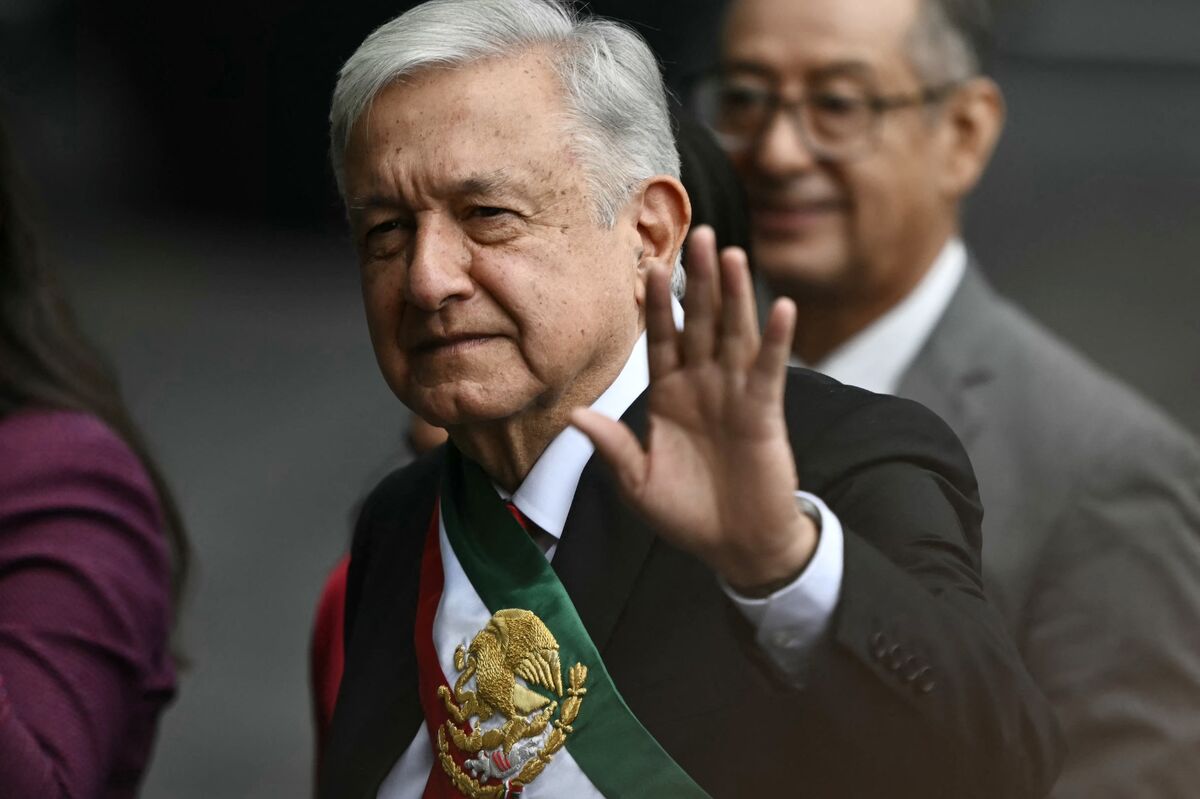
Former Mexican President Andres Manuel Lopez Obrador publicly backed President Claudia Sheinbaum and criticized rising US pressure on her government. The article is primarily political and diplomatic in nature, with no direct policy action or economic data. Market impact is limited, though the renewed US-Mexico tension could add uncertainty for Mexican assets.
This is less about one politician’s endorsement than about regime signaling: AMLO re-entering the conversation materially raises the perceived policy ceiling for Sheinbaum and lowers the odds of near-term internal party fragmentation. In the near term, that should compress Mexico risk premia modestly because markets care most about continuity of the current governing coalition and whether the presidency can absorb external pressure without losing domestic legitimacy.
The second-order effect is that US pressure may become politically counterproductive if it is seen as empowering a nationalist backlash. That dynamic usually benefits assets tied to domestic demand and fiscal continuity while hurting sectors with high US-regulatory dependence, especially autos, logistics, and any cross-border supply-chain names with heavy compliance exposure. The more important medium-term question is whether this becomes a template for higher intervention risk in trade, energy, or judicial matters, which would matter more over months than days.
Consensus likely underestimates how quickly Mexican asset correlations can break if the message is interpreted as a stability signal rather than a confrontation signal. If Sheinbaum uses the moment to harden rhetoric but preserve policy continuity, the peso can outperform on carry alone; if not, the move reverses quickly because Mexico is still highly sensitive to USMCA headlines and US manufacturing reshoring flows. The contrarian read is that this may actually reduce tail risk by clarifying the domestic power structure, even if the headlines look more tense.
The key catalyst window is the next 2-8 weeks: any escalation in bilateral pressure, tariff language, or judicial/energy disputes will determine whether this is a short-lived political noise event or the start of a wider de-risking cycle for Mexico exposures.
AI-powered research, real-time alerts, and portfolio analytics for institutional investors.
Request DemoOverall Sentiment
neutral
Sentiment Score
-0.10
