
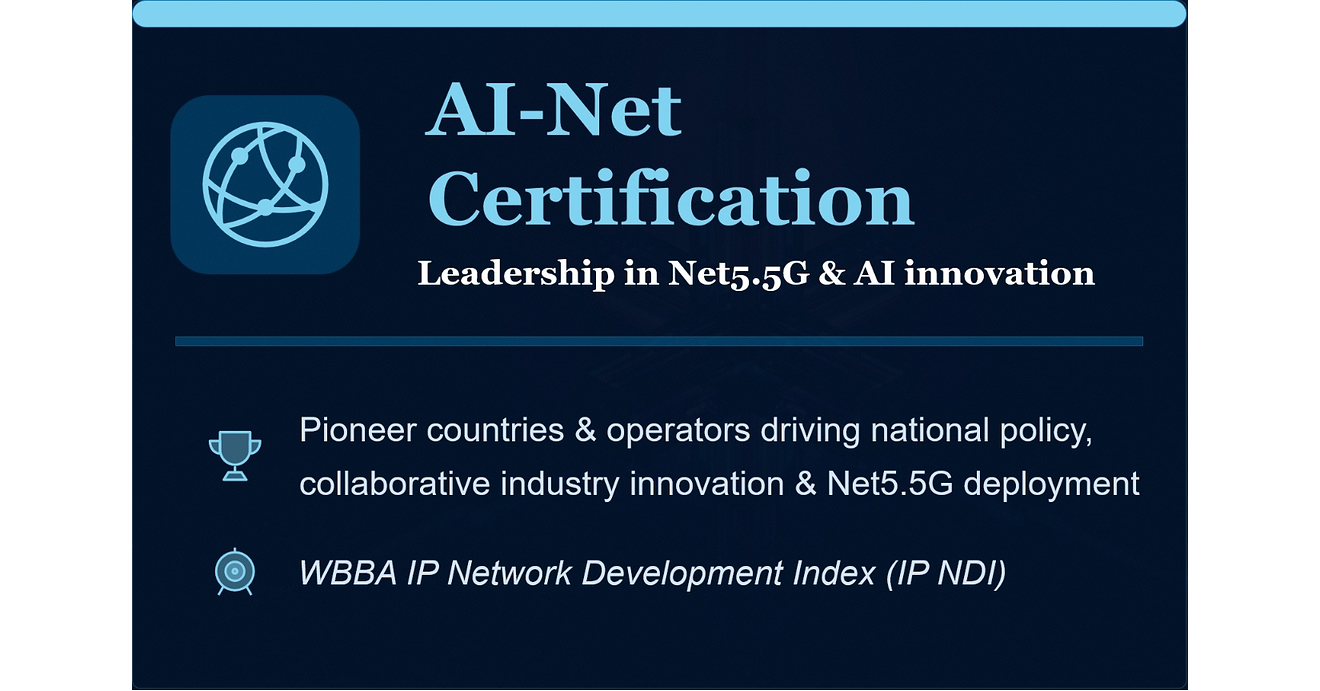
WBBA (World Broadband Association) oficiálne spustila program AI-Net, globálnu certifikáciu dátovej komunikácie pre krajiny a operátorov, ako míľnik pri prechode z „All-Cloud“ na „All-Intelligence“. Certifikácia má tri piliere (národné politické usmernenia, spolupracujúce odvetvové ekosystémy a miera penetrácie Net5.5G) a hodnotí siete cez deterministický výkon (vysoká priepustnosť, nulová strata paketov, ultranízka latencia) a „AI pre sieť“ (endogénna inteligentná samooptimalizácia). Celkovo ide o pozitívny, no skôr odvetvový (nie bezprostredne trhový) rámec pre urýchlenie zavádzania Net5.5G do roku 2030.
The practical winner is not the standards body; it is the small set of vendors that can monetize “compliance-as-a-platform” and pre-integrated AI-network reference designs. That tends to favor diversified networking names and optical/transport suppliers with strong operator relationships, while penalizing niche vendors that rely on custom deployments and long integration cycles. If operators take this seriously, the first-order spend is on routing/switching, automation software, and backbone upgrades; the second-order effect is procurement consolidation toward incumbents with certification credibility and global service footprints.
Near term, this is mostly narrative support rather than a hard demand signal. The real catalyst is whether national telecom regulators or Tier-1 operators embed the framework into procurement rules over the next 1-3 quarters; without that, the release is just a longer-duration capex “option” on AI traffic growth. A failure mode is that operators use the language to justify internal rebranding while delaying spend, which would leave equipment orders flat and compress multiple expansion expectations.
Contrarianly, the market may overrate how much AI traffic translates into incremental telecom EBITDA. Most of the value accrues to hyperscaler and cloud interconnect layers, while carriers still face intense pricing pressure and high depreciation; better networks can raise quality, but not necessarily returns on capital. The more interesting trade is to own the enablers of backbone complexity reduction, not the broad telecom basket, and to fade any move in lower-quality carriers that lack balance-sheet room to monetize the standard.
Watch for three falsifiers: no pickup in operator capex commentary over the next two earnings cycles, no mention of AI-network standards in procurement or regulatory language, and no improvement in automation/latency metrics that would justify premium multiples. If those do not appear, this remains a sentiment tailwind, not an earnings driver.
AI-powered research, real-time alerts, and portfolio analytics for institutional investors.
Request TrialOverall Sentiment
mildly positive
Sentiment Score
0.35
Ticker Sentiment
