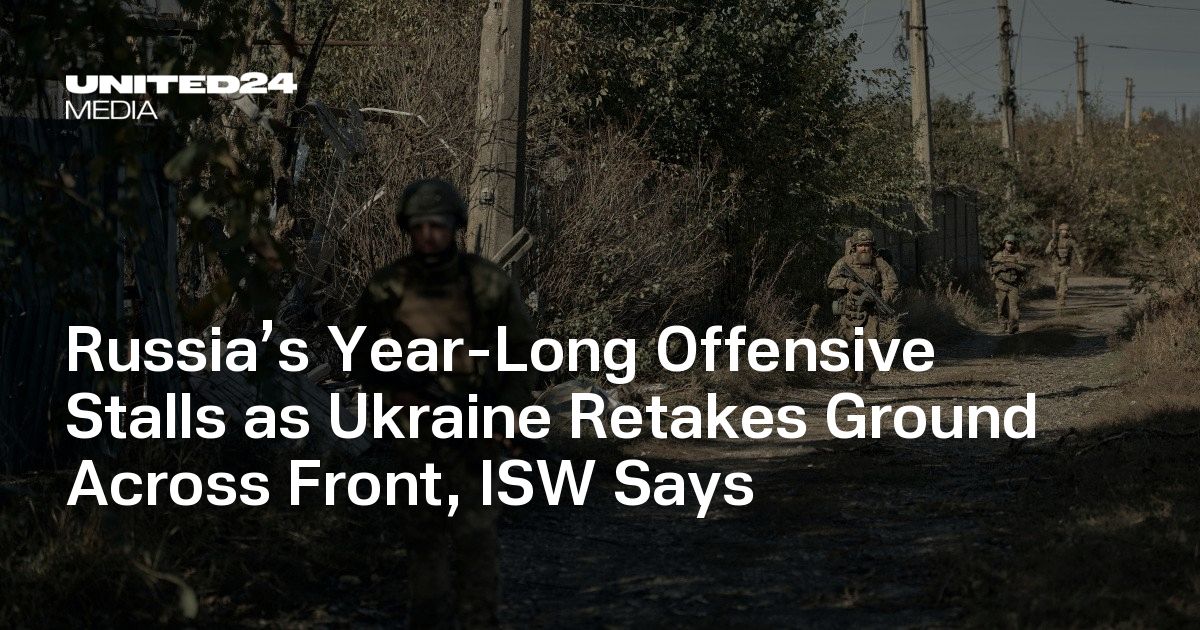
Russia’s year-long offensive has failed to produce any significant operational breakthroughs, while Ukraine said it retook large parts of Kupiansk and more than 400 square kilometers in southern Ukraine during winter and spring 2026. ISW also said Ukrainian long-range strikes are disrupting Russian logistics, communications, and oil revenues, while ceasefire violations and Starlink restrictions continue to complicate battlefield operations. The developments point to a prolonged, costly war with elevated implications for defense, energy, and regional risk markets.
The market implication is not “peace premium” so much as a grinding deterioration in Russia’s marginal ability to convert spending into battlefield progress. That matters because the next phase is likely to be more capital- and logistics-intensive for Moscow: if offensive gains remain incremental, the burden shifts toward sustaining force generation, equipment replacement, and rear-area protection, which is typically negative for the broader Russian industrial complex and especially energy-linked fiscal revenue.
The more interesting second-order effect is on the supply chain for war-related procurement. Persistent Ukrainian interdiction raises the expected cost of moving fuel, drones, communications gear, and spare parts farther from the front, which tends to favor geographically diversified defense contractors, electronic warfare suppliers, and satellite connectivity providers outside Russia. It also argues for a wider dispersion of demand across air defense, counter-UAS, and long-range precision strike systems, rather than a single “munitions shortage” trade.
Energy is the cleaner macro transmission. If Russian export infrastructure remains a recurring target, the risk is not just volumetric disruption but higher insurance, shipping, and discount pressure on Urals-linked flows, which can tighten non-Russian crude balances at the margin and lift refined product volatility. The key point is timing: this is a months-long attrition story, not a one-week headline, so the market can underprice cumulative degradation until it shows up in budget stress, export discounts, or inventory draws.
Contrarian takeaway: the current narrative may be too linear on both ceasefire probability and Russian resilience. A temporary tactical pause can improve Russia’s near-term positioning, but if Ukraine keeps forcing logistical dispersion, Moscow may face a worse risk/reward profile for another large offensive than the market assumes. The upside surprise is a further extension of the stalemate that slowly tightens Russian fiscal and operational constraints without requiring a dramatic front collapse.
AI-powered research, real-time alerts, and portfolio analytics for institutional investors.
Request DemoOverall Sentiment
mildly negative
Sentiment Score
-0.35
