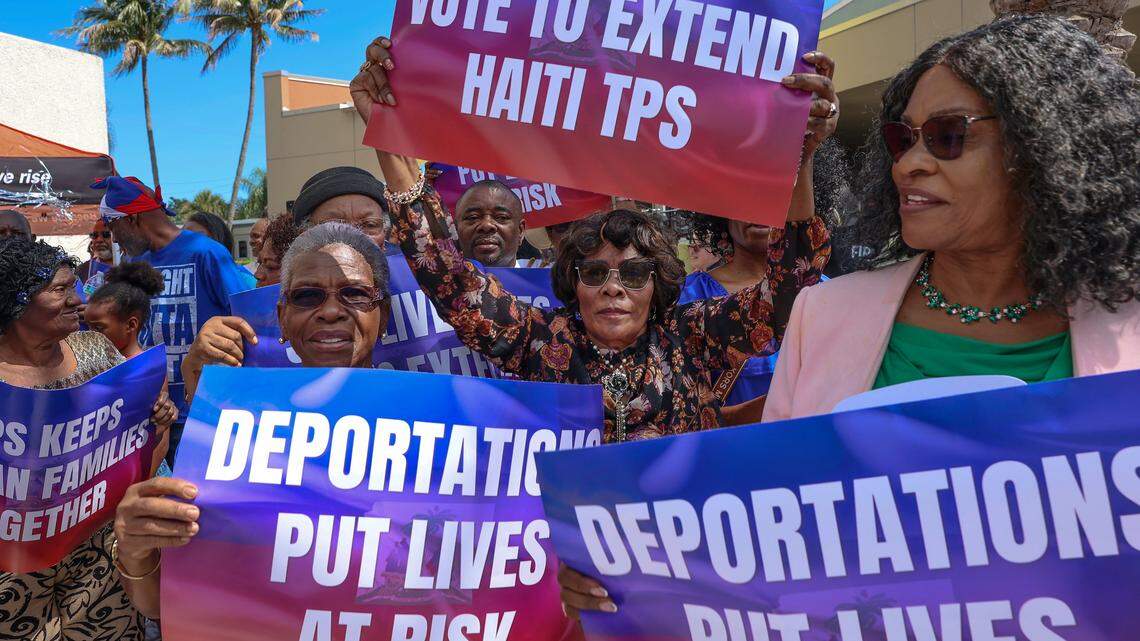
The U.S. Supreme Court is weighing whether the Trump administration can terminate TPS for roughly 350,000 Haitians and about 6,000 Syrians, a decision that could also affect an estimated 1.3 million TPS holders from other countries. The case hinges on whether federal courts can review TPS terminations and has already led to multiple lower-court rulings blocking the administration’s actions. A ruling for the government could accelerate deportation risk and broaden policy implications across Venezuela and other TPS-designated countries.
The market read-through is less about direct asset exposure and more about labor supply, municipal demand, and EM spillovers. A loss for TPS holders raises the probability of a sharp but uneven labor shock in hospitality, construction, elder care, logistics, and food service in South Florida, Texas, and DC-area pockets where these workers are concentrated; that is mildly inflationary at the low end of the wage stack and supportive for local employers with pricing power, while pressuring labor-intensive SMEs. The second-order effect is that the issue is not binary: even if the Supreme Court narrows judicial review, the administrative lag before enforcement, plus likely injunctions on parallel cases, means the labor disruption would probably unfold over quarters rather than days.
The bigger signal for markets is precedent. If the Court blesses the executive’s discretion here, it expands policy optionality for a broader immigration reset that could be used across multiple designations, increasing uncertainty around labor availability in sectors already operating with thin staffing buffers. That creates an asymmetric risk for small-cap consumer, regional restaurant, homebuilder, and freight names with heavy exposure to immigrant labor, while national platforms with automation and tighter wage control can absorb the shock better. EM sovereign sentiment is also a quiet channel: Haiti and Syria are not investable directly, but tighter U.S. pathways and forced return risk worsen remittance stability and local humanitarian conditions, which can widen geopolitical risk premia around Caribbean and Levant exposures.
The contrarian angle is that the near-term equity impact may be overestimated relative to headlines. A ruling for the government would not instantly remove the entire cohort from the labor force, and many firms have already been de-risking via wage inflation, subcontracting, and undocumented labor substitution; the immediate earnings impact may be limited, while political and operational uncertainty remains elevated. The cleaner trade is to focus on companies with measurable immigrant labor sensitivity rather than broad indices, and to use volatility around the decision as an entry point rather than chasing a one-day reaction.
Catalyst timing matters: the court event is a days-to-weeks volatility trigger, but the practical labor and consumer effects, if any, would likely emerge over 1-3 quarters as work authorization rolls off and employers rehire at higher cost. The tail risk is a ruling that effectively insulates TPS decisions from review, which would widen policy optionality beyond this case and keep immigration-related labor tightness in play through year-end.
AI-powered research, real-time alerts, and portfolio analytics for institutional investors.
Request DemoOverall Sentiment
moderately negative
Sentiment Score
-0.35
