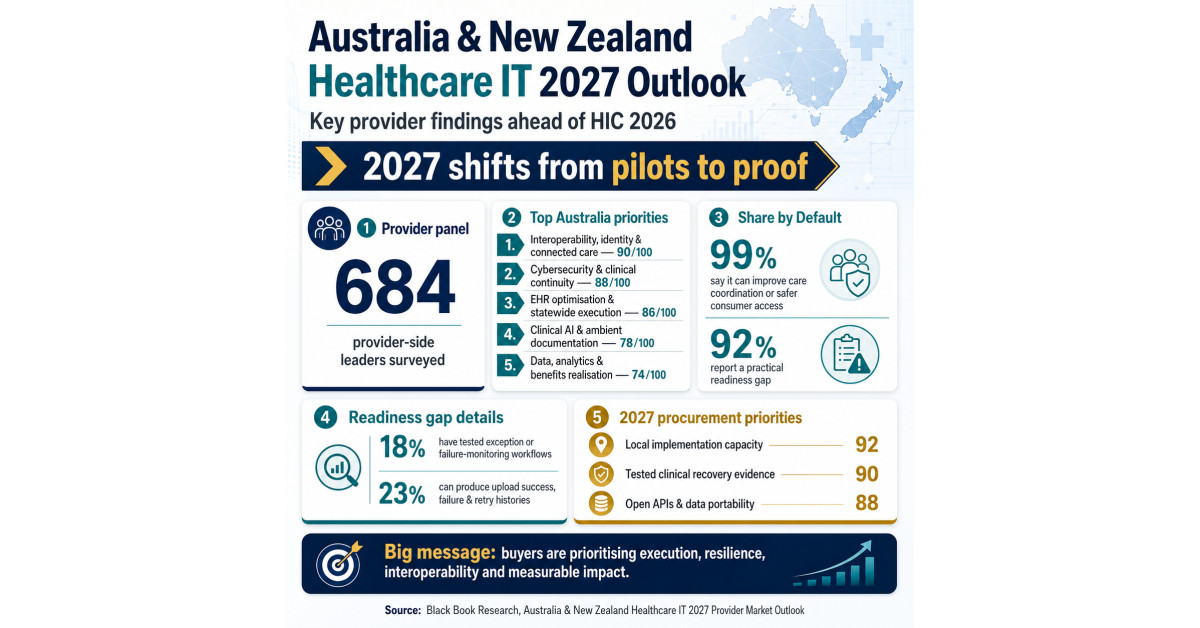
Black Book Research’s Australia & New Zealand Healthcare IT 2027 outlook (based on 684 provider leaders) says Australia is entering a more active buying cycle but vendors face a higher “burden of proof” versus feature-led pilots. Interoperability (priority index 90), cybersecurity/clinical continuity (88), and statewide EHR execution (86) are the top procurement drivers, with providers emphasizing production reliability and clinical recovery evidence. A separate Share by Default survey found a readiness gap: 92% reported practical gaps despite 99% believing it could improve coordination, with only 18% having tested failure/exception monitoring workflows.
This read-through is more about procurement tilt than incremental budget size. The immediate implication is a quality premium for vendors with on-the-ground implementation, downtime recovery, auditability and local support, which tends to favor incumbents and large platforms over pure-feature point solutions. That supports MSFT and ORCL more as operating-system style beneficiaries than as “AI narrative” names; the market should care less about headline capability and more about whether these vendors can reduce integration friction and pass clinical continuity tests.
The second-order loser set is the long tail of healthcare software vendors whose sales motion depends on demo strength but whose delivery model leans on partners. If buyers start scoring on failure logs, data portability and outage workflows, then services-heavy integrators and cybersecurity specialists capture more wallet share while standalone SaaS names face longer sales cycles and heavier pilot conversion risk. That dynamic can compress revenue visibility for smaller vendors even if aggregate healthcare IT spend rises.
The contrarian point: this is probably not an immediate spending acceleration signal; it is a buying-criteria shift. In the next 1-3 months, the market may overreact to “AI and interoperability” as a growth theme, but the actual winners will be determined by procurement defensibility and implementation capacity over 6-18 months. Falsifier: if state/federal rollouts stall, or if RFP language remains feature-led rather than evidence-led, the read-through to listed vendors will be mostly noise rather than a durable revenue catalyst.
AI-powered research, real-time alerts, and portfolio analytics for institutional investors.
Request DemoOverall Sentiment
neutral
Sentiment Score
-0.05
Ticker Sentiment
