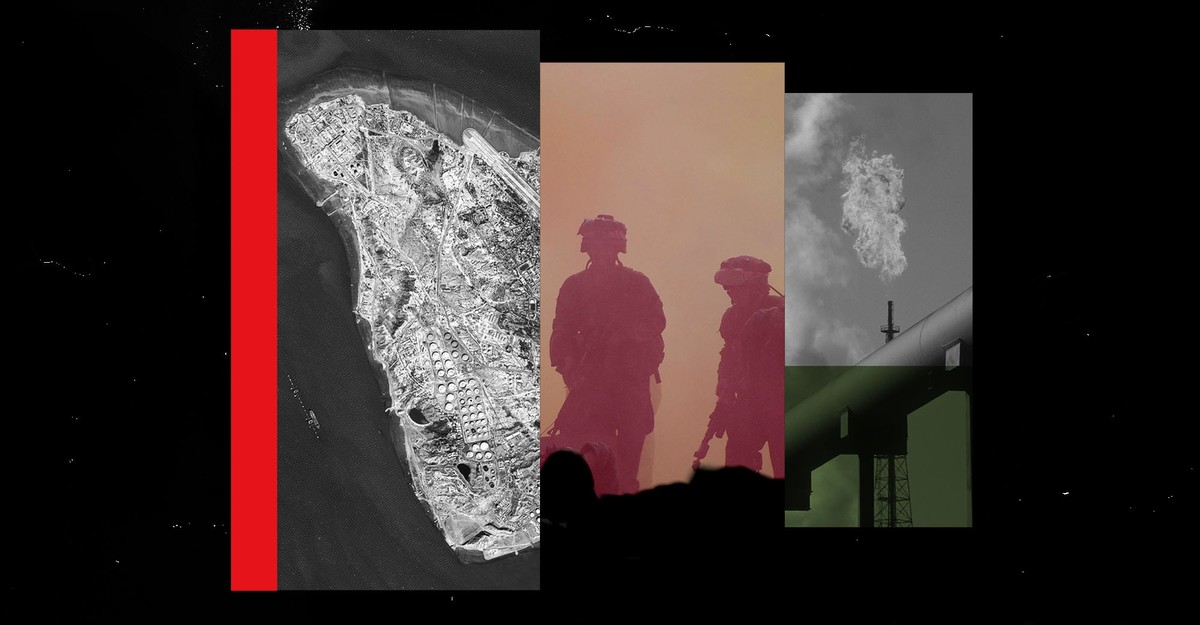
Kharg Island handles roughly 90% of Iran’s oil exports and the U.S. has struck targets there (March 13) while reportedly considering an invasion; Iran has exported an estimated 16 million barrels since the war began. Seizing the ~8 sq. mile island (pop. ~20,000) with a ~2,200–2,500 Marine rapid-response force could choke Iranian oil flows but risks major escalation (ballistic missiles, loitering munitions, oil fires), severe logistical vulnerabilities (5,922-ft runway at risk; island ~140 miles from Kuwait), and pronounced upside pressure on global oil prices and supply-chain routes (Strait of Hormuz, Bab el-Mandeb/Suez).
Seizing a node that materially affects regional exports would compress spare capacity and operational flexibility, so the immediate market response will be driven more by insurance/freight premia and shorter-haul inventory dynamics than by physical barrels changing hands. Market-impact models calibrated to prior Gulf shocks imply that a sustained disruption equivalent to a few percent of global seaborne flows can add roughly $5–12/bbl to Brent in the first 30–90 days via risk premia alone, with tanker rates (VLCC/AFRA) rising multiples faster.
Operationally, the decisive constraint is logistics under fire: any holding force will face asymmetric counters (loitering munitions, SRBMs, maritime drones) that raise the marginal cost of resupply and raise casualty risk, making the “hold” timeframe uncertain and binary from a market perspective — either short sharp disruption or grinding attritional standoff. That binary increases option value on convex securities: freight insurers, reinsurers, and dedicated tanker owners typically capture outsized upside in short windows while integrated firms with refining exposure exhibit more ambiguous responses.
Politically, the dominant catalyst is not military success but domestic tolerance in key consuming states; a near-term election calendar compresses decision windows and raises the probability of an expedited diplomatic off-ramp within 1–3 months, which would reverse much of the initial price shock. Conversely, decade-level structural effects (accelerated strategic storage, re-routing costs, and higher insurance normalization) would take 6–24 months to crystallize and support a higher long-term cost of risk for seaborne energy trade.
AI-powered research, real-time alerts, and portfolio analytics for institutional investors.
Request DemoOverall Sentiment
strongly negative
Sentiment Score
-0.60
