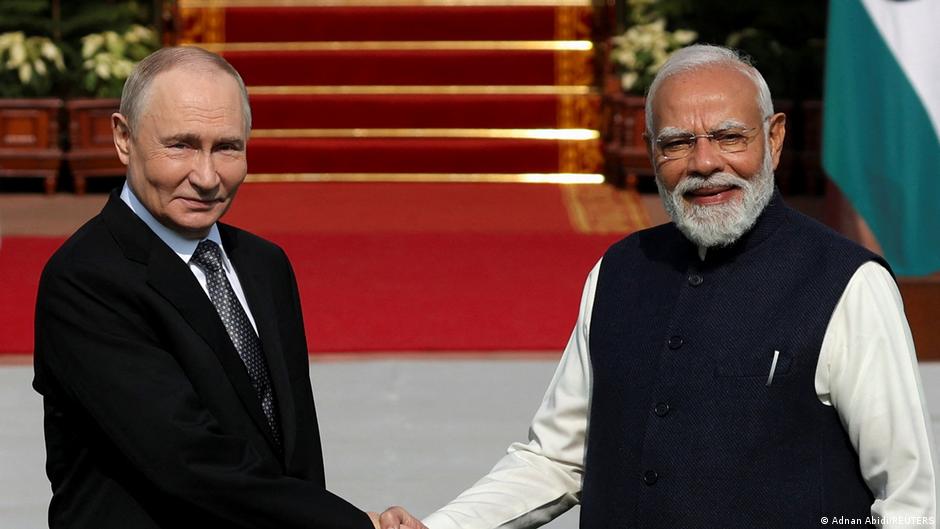
During a two-day state visit to New Delhi, Vladimir Putin pledged 'uninterrupted' supplies of Russian oil, gas and coal to India and signed multiple cooperation agreements while leaders set a bilateral trade target of $100 billion by 2030 (up from about $68.7 billion). India signaled caution — citing sanctions, evolving commercial dynamics and recent US tariffs — even as deals were announced including a fertilizer JV in Russia, a planned nuclear plant in southern India and plans to reorient defence ties toward joint R&D; Russia supplied roughly 1.8 million barrels per day to India in 2024 (about 36% of India's crude imports).
Market structure: India continuing to take ~1.8m bpd of discounted Russian crude keeps Asian seaborne flows elevated and preserves refining margins for Reliance/Indian refiners (benefit to INDA constituents). Winners: Indian refiners, VLCC/tanker owners, domestic defence suppliers; Losers: Russian producers facing margin discounts, Western insurers/banks exposed to secondary-sanction risk. Net effect: ceteris paribus this caps upside in Brent by ~$5–10/bbl vs. a sanction-driven spike, but raises shipping rates and oil volatility.
Risk assessment: Tail risks include (A) US/third‑party secondary sanctions on Indian counterparties (low prob, high impact) and (B) abrupt insurance/payment rail cutoffs that disrupt shipments; either can push Brent +20–40% in weeks. Immediate (days): headline volatility; short-term (weeks–months): rerouting and insurance repricing; long-term (to 2030): structural India–Russia industrial/defence ties reshape capex and import composition. Hidden dependencies: insurance pools, SWIFT/payment workarounds, and India’s diplomatic balancing with US trade talks.
Trade implications: Tactical plays: buy India equity exposure to capture cheaper feedstock and defense capex, hedge tail-risk via puts; buy short-dated Brent dispersion (3‑month call spread) to profit from sanction spikes while limiting premium. Cross-asset: consider long tanker equities (STNG/EURN) for 3–6 months to capture higher freight; modest short USD/INR forwards if Brent down $8–10 and INR strengthens ~1–2%.
Contrarian angles: Market underestimates that India will maintain large Russian oil intake absent explicit US secondary sanctions — so INDA/Indian refiners may be underpriced for 6–24 months. Conversely, tanker equities may already underprice sustained high freight from rerouting. Historical parallel: 2014 sanctions saw volumes reroute and discounts widen for 6–18 months before normalization; expect similar asymmetric risk-reward for 3–12 month trades.
AI-powered research, real-time alerts, and portfolio analytics for institutional investors.
Request DemoOverall Sentiment
mixed
Sentiment Score
-0.05
Ticker Sentiment
