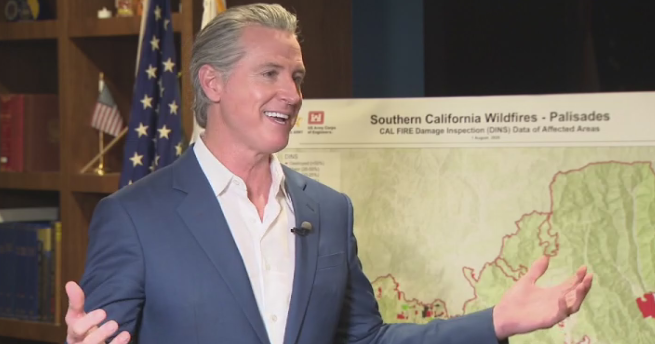
California Gov. Gavin Newsom flagged concern about a crowded Democratic field ahead of the June 2 open gubernatorial primary, citing February PPIC polling that shows conservative commentator Steve Hilton at 14%, Democrat Katie Porter 13%, Republican Chad Bianco 12%, Rep. Eric Swalwell 11% and Tom Steyer 10%, with 30% supporting other candidates and 10% undecided—under the top-two primary system that raises the risk of two Republicans advancing. Newsom declined to endorse but signaled a possible future intervention; he also touted Proposition 50’s effects in flipping Trump-won counties and said new maps could add as many as five Democrats to the U.S. House. Separately he pressed for federal cooperation on wildfire rebuild funding and expedited/waived local permitting fees, and criticized DHS immigration deployments after recent incidents and ICE arrest data (under 14% tied to violent offenses) and reported pullbacks in Minnesota following protests.
Market structure: Short-term winners are building-materials and regional contractors servicing rapid rebuilds (aggregates, concrete, framing) as permit-waivers and waived fees compress approval timelines; expect 3–9 month demand uplift that can lift revenue for VMC/MLM by mid-teens percent relative to baseline. Losers: property & casualty insurers and county-level budgets that absorb waived fees and acceleration costs; stress on local finances could push longer CA muni yields wider by 30–150bps if outlays rise materially.
Risk assessment: Tail risks include a GOP top-two runoff in June that leads to abrupt state-level policy shifts (tax or pension reforms) causing CA muni spreads to gap wider (50–150bps) within 3–12 months, and an escalation of federal-state clashes over DHS deployments that could produce headline volatility in social-services and safety budgets. Hidden dependencies: federal disaster aid timing is decisive — if the administration front-loads funds within 30–90 days, construction demand surges; if delayed, credit stress and contractor insolvency risk rise over 6–12 months.
Trade implications: Favor tactical exposure to materials (VMC, MLM) via 3–6 month call spreads to capture rebuild demand; defensively shorten long-duration CA muni exposure and add 1–2% portfolio protection in P&C insurers (short-dated puts) sized to potential 5–20% claims shocks. Use the June 2 primary and midterms as binary catalysts to trim/scale positions within a 2–4 week window after results.
Contrarian view: The consensus fear of a Democratic “doomsday” is likely overstated—30% “other” + 10% undecided means high dispersion rather than a settled GOP sweep, so CA-specific political-risk premia in munis and regional construction stocks may be overbaked. If CA muni spreads widen >30bps on headlines (vs. national muni curve), that is a buy signal for 1–3 year IG CA munis; conversely, if primary volatility collapses, expect a quick mean-reversion in small-cap regional contractors.
AI-powered research, real-time alerts, and portfolio analytics for institutional investors.
Request TrialOverall Sentiment
neutral
Sentiment Score
0.00
