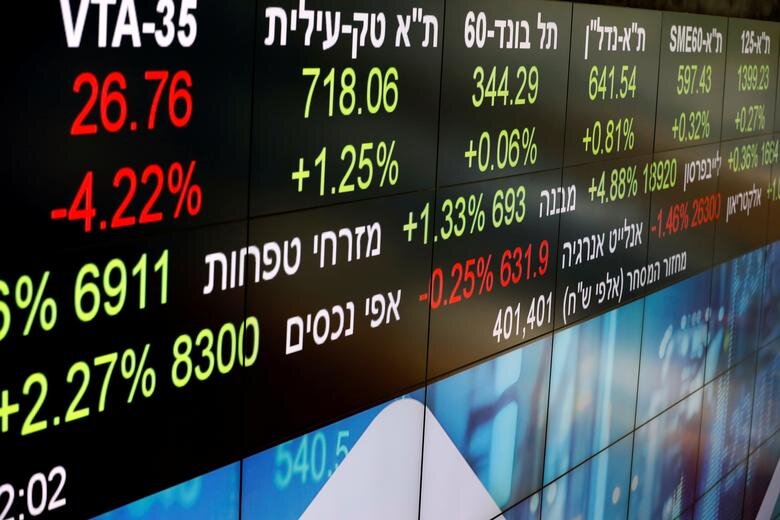
Israeli stocks fell 0.84% in Tel Aviv, with decliners outnumbering advancers 376 to 112 as Communication, Insurance and Oil & Gas sectors led losses. Tower Semiconductor surged 15.07% to a 5-year high, while Camtek dropped 8.11% and Clal Insurance fell 5.81%. Commodities were mixed: crude oil rose 0.62% to $102.81, Brent slipped 0.36% to $107.38, and USD/ILS was unchanged at 2.91.
The cleanest read-through is not the headline move itself but the market’s message about where marginal capital is being reallocated: semis with Israel exposure are being treated as a geopolitical beta trade, while defense-adjacent electronics are being de-rated on any sign of trade friction. TSEM’s surge suggests positioning was light and the float is vulnerable to sharp squeezes when a catalyst collides with a crowded underweight; that can persist for days, but the move likely overshoots fundamental revisions in the near term.
CAMT looks more interesting on the downside because the selloff likely reflects de-risking in the same local tech basket rather than a single-name deterioration. If this is flow-driven, the second-order effect is that any sustained strength in TSEM could temporarily siphon capital away from other Israeli hardware names, creating a relative-value dislocation that may last 1–3 weeks. ORA’s bid is harder to justify on the surface, but it benefits from a lower-beta, real-asset profile when FX is stable and energy prices are firm; that makes it a natural parking spot for domestic investors rotating out of higher-volatility growth.
The contrarian angle is that the market may be underestimating how quickly the move in TSEM can fade if the catalyst is headline-driven rather than order-book driven. If follow-through volume is weak, this looks like a classic gap-and-go candidate that can retrace 30-40% of the spike within 5-10 sessions. Conversely, CAMT may be closer to a tradable overshoot than a structural short, because the business has more earnings sensitivity to broader semiconductor capex cycles than to a single day of local sentiment.
AI-powered research, real-time alerts, and portfolio analytics for institutional investors.
Overall Sentiment
neutral
Sentiment Score
-0.05
Ticker Sentiment
