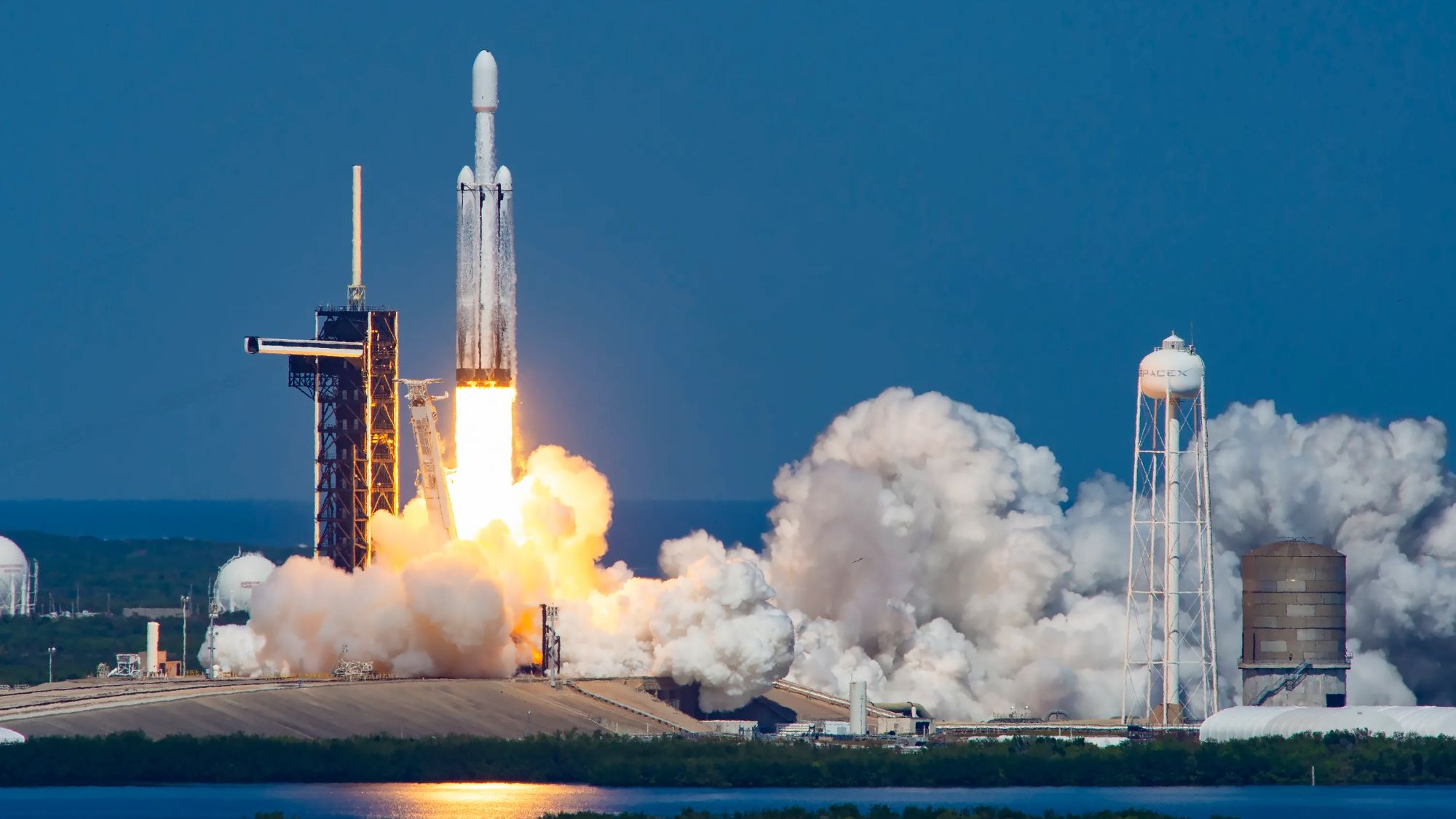
SpaceX is set to launch Falcon Heavy for the first time in 18 months on April 27, carrying ViaSat-3 F3 to geostationary orbit during an 85-minute window starting at 10:21 a.m. EDT. The mission marks the rocket's 11th flight and supports ViaSat's broadband expansion into the Asia-Pacific region, with the two side boosters expected to land back in Florida about eight minutes after liftoff. The article is primarily an operational update with limited near-term market impact.
VSAT is the cleaner expression here than TSLA. The immediate marketable signal is not the launch itself, but the start of revenue recognition and insurance/installation milestones tied to a multi-quarter capacity ramp; that tends to matter more for near-term sentiment than the satellite’s long-duration economics. If this flight goes cleanly, it de-risks the final leg of a program that has already been partially validated by predecessor deployments, which should support multiple expansion in a stock that still trades like execution risk is binary.
The second-order beneficiary is SpaceX’s launch cadence and pricing power, even though TSLA holders may be tempted to read this as a brand-positive event. A successful Falcon Heavy return-to-service reinforces SpaceX’s reliability for the largest payload class, which matters because it protects share in the small but strategic market where customers care more about schedule certainty than marginal launch price. The loser is any incumbent heavy-lift provider that competes on national-security or large GEO payload access; a clean mission makes it harder to argue that alternative launchers offer a materially better reliability-adjusted value proposition.
The key risk is not launch failure per se, but post-launch anomaly risk in orbit: GEO deployments create a long tail of value leakage if the spacecraft needs extra station-keeping, suffers power/comms degradation, or enters service late by even one quarter. That matters because the investment case is increasingly about monetizing capacity in a tight competitive window; a 3-6 month delay can push utilization into a softer pricing environment and compress the implied IRR materially. On the flip side, a successful deployment may be underappreciated because the market often treats satellite launches as event-driven rather than as catalysts for recurring revenue ramps.
Contrarian view: the market may be overfocusing on launch optics and underweighting that the better trade is the gradual de-risking of a capital-intensive asset into service. For TSLA, this is probably noise unless you believe it improves SpaceX financing optionality or private-market valuation enough to spill into public sentiment; that spillover is weaker than headline readers assume. The higher-probability move is a slow grind higher in VSAT as the network effect from a completed constellation becomes more visible to customers and credit markets.
AI-powered research, real-time alerts, and portfolio analytics for institutional investors.
Request DemoOverall Sentiment
neutral
Sentiment Score
0.15
Ticker Sentiment
