


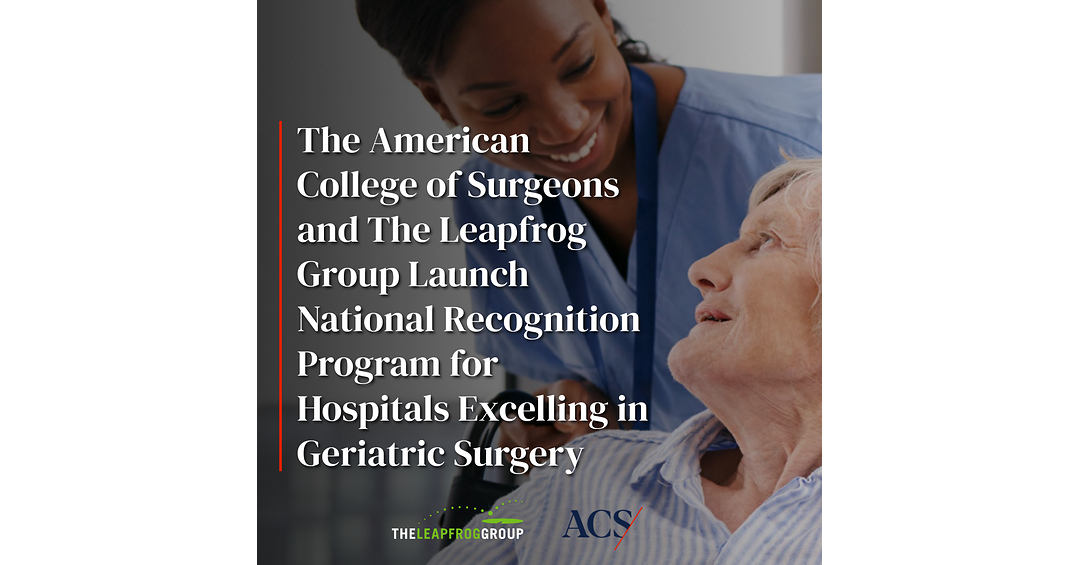
The American College of Surgeons (ACS) and The Leapfrog Group launched the “Recognized Leader in Geriatric Surgery” designation, with hospitals eligible to earn it starting in 2027. To qualify, hospitals must participate in the ACS Geriatric Surgery Verification (GSV) program, achieve an A or B Leapfrog Hospital Safety Grade, and demonstrate strong performance on patient-safety measures (including medication safety practices like computerized prescriber order entry, bar code medication administration, medication reconciliation, and safe surgery checklists). The initiative aims to give patients and payers clearer signals of safe, patient-centered surgical care for older adults.
This is a low-immediate-impact quality signaling event, not a near-term revenue catalyst. The real economic mechanism is procurement and referral steering: once employers, MA plans, and high-acuity referral networks start using the designation, hospitals that already screen well on geriatric pathways can capture a higher share of elective orthopedic, vascular, and general surgery volume from older patients. That favors large systems with capital and process discipline, while smaller community hospitals face an incremental compliance burden that could widen the quality gap over 12-24 months.
The second-order winner is the ecosystem that sells the underlying workflow: EHR modules, medication-safety tools, discharge planning, and perioperative analytics. The article does not identify vendors, but the standards imply more demand for CPOE, barcoding, reconciliation, and care-coordination software. That is structurally more relevant than the designation itself; the badge is just the customer-facing wrapper that can justify budget approval for IT and nursing process upgrades.
Consensus risk is overestimating how quickly patients change behavior. Most surgical volume is still physician-led and insurance-network constrained, so the designation is likely to matter first in employer contracting and plan design, not in consumer search behavior. Falsifiers: if no major payer incorporates the badge into network tiering by 2027, or if accreditation participation remains limited, the economic effect stays mostly reputational. For GOOGL, the impact is effectively noise unless hospital-quality data becomes a meaningful search/ads vertical, which is a multi-year stretch.
Net: mildly positive for quality-leading hospital systems and healthcare IT vendors, but too early for a high-conviction public-equity trade on the headline alone. The best setup is to watch for a broader adoption list and whether large integrated systems or academic centers disproportionately enroll; that would signal a real competitive moat around geriatric surgical capacity.
AI-powered research, real-time alerts, and portfolio analytics for institutional investors.
Request TrialOverall Sentiment
mildly positive
Sentiment Score
0.12
Ticker Sentiment
