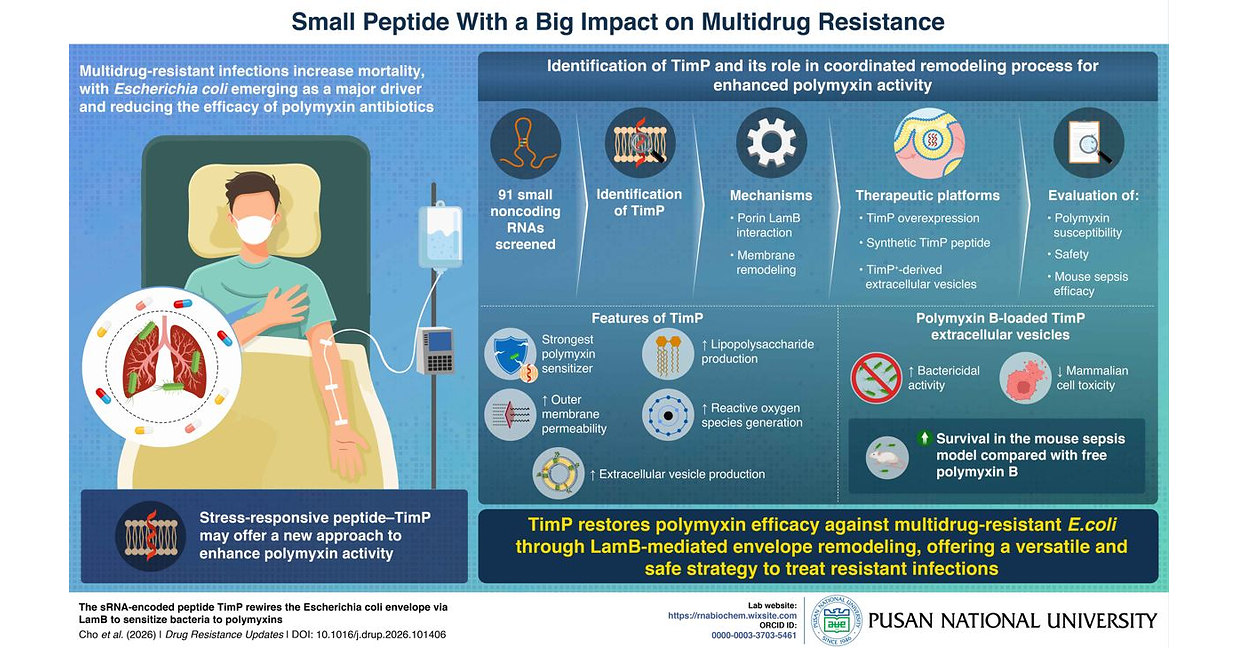
Researchers from Pusan National University reported an extracellular vesicle platform (PMB@TimP EVs) that enables polymyxins to kill multidrug-resistant MDR gram-negative E. coli at potentially lower and safer doses by rewiring bacterial membranes via the TimP peptide. In a murine MDR E. coli sepsis model, PMB@TimP EVs improved survival where free polymyxin B (PMB) failed, with mammalian-cell toxicity described as minimal and safety studies showing no abnormal organ accumulation. The work is preclinical and calls for broader safety/efficacy testing before human trials, but it represents a promising “adjuvant” approach to reduce reliance on last-line antibiotics.
This is scientifically interesting but not a near-term public-market catalyst. The economic value, if real, accrues only after a long translational chain: preclinical reproducibility, toxicology, IND-enabling work, then multi-year clinical validation in hard-to-run infection endpoints. In the meantime, the read-through is mostly to platform-value optionality for anti-infective developers, not to hospital systems or broad biotech earnings.
The bigger second-order implication is competitive: if a membrane-sensitizing adjuvant works, it extends the life of legacy antibiotics and shifts power away from pure de novo-antibiotic discovery toward combination/delivery platforms. That could be favorable for specialty drug-delivery IP holders and for companies with already-approved anti-infective assets, while pressuring firms whose thesis depends on a single novel antibiotic command premium pricing. But the base rate on academic antimicrobial claims is low, so the market should discount this heavily until human safety data arrive.
Contrarian view: consensus will likely over-assign near-term value because sepsis and MDR infections are emotionally compelling headlines. The real bottleneck is not potency in a mouse model; it is manufacturability, immunogenicity, pharmacokinetics, and whether the added component can survive regulatory scrutiny without offsetting toxicity. If this becomes investable, it is a 6-18 month watch item for IND filing and partnering, not a days-to-weeks trade.
AI-powered research, real-time alerts, and portfolio analytics for institutional investors.
Request DemoOverall Sentiment
strongly positive
Sentiment Score
0.55
