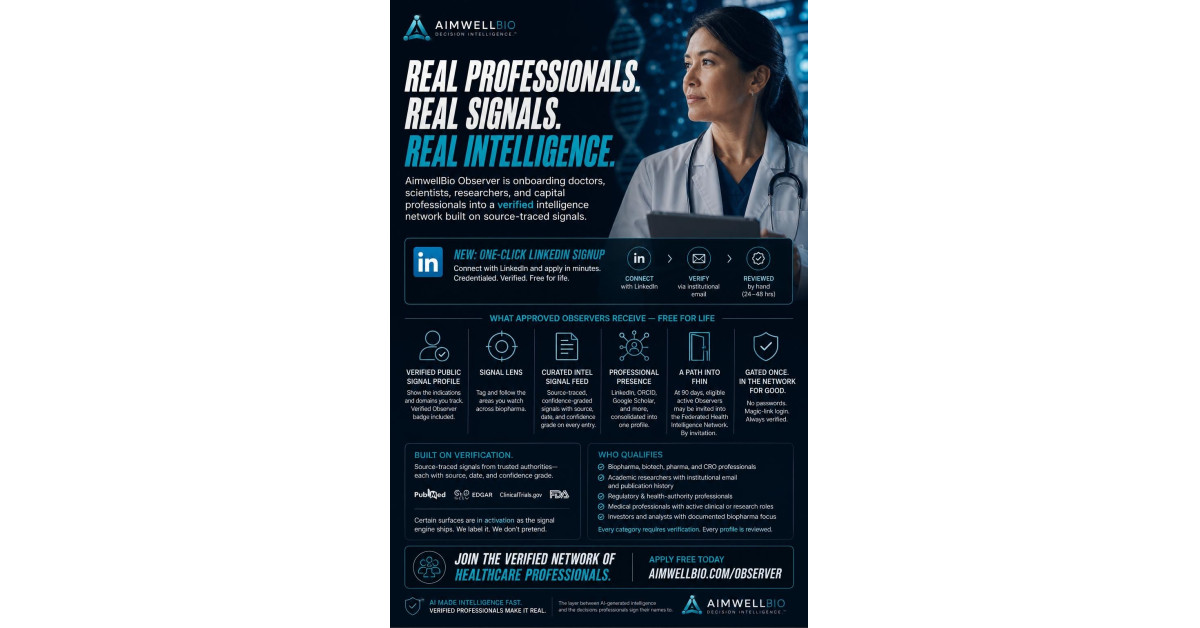
Aimwell Partners (OTC:AIMN) published the Adversarial Validation Standard v1, an open methodology framework for validating AI-generated biopharma intelligence with an evidence-chain, multi-agent audit, confidence scoring, and hallucination containment. The firm positions the standard as a way to reduce financial/legal/regulatory risk from unverified AI outputs and says it underpins its Federated Health Intelligence Network (FHIN) with an abridged ~25-page public edition. Pricing starts at $229/month for platform access, with observer-level access for credentialed professionals offered at no cost.
This reads more like a procurement and trust signal than a revenue catalyst. In regulated biopharma, the economic value is not the model itself but whether the buyer can defend the output to legal, QA, and regulators; that shifts budget power toward vendors with audit trails, provenance, and workflow embedding. As a result, the long-run winner is usually not the flashiest AI layer but the platform that becomes the system of record for validated decisions.
For AIMN, the near-term effect is mostly narrative optionality. The market may reward the word "standard," but the hard test is conversion: does this actually shorten enterprise sales cycles, raise ACV, or improve retention? Without disclosed paid deployments or recurring revenue traction, OTC names like this often see a quick sympathy bid and then mean-revert once investors realize the press release is not a financial statement.
The contrarian view is that the market may underprice the moat from methodology in a liability-heavy vertical. If the standard becomes a de facto procurement requirement, smaller black-box AI providers could face a higher hurdle and slower adoption, while incumbents in life-science software, CROs, and data-governance tooling capture the spend. Still, once the methodology is public, it is also replicable; the durable advantage is distribution and customer trust, not the framework alone.
AI-powered research, real-time alerts, and portfolio analytics for institutional investors.
Overall Sentiment
mildly positive
Sentiment Score
0.12
Ticker Sentiment
