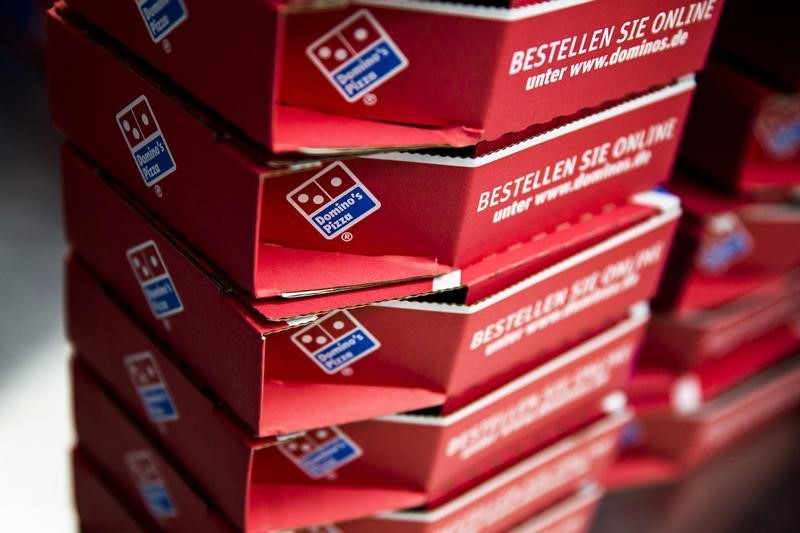
Cynthia A. Headen sold 1,745 shares of Domino’s at $399.60 on March 11, 2026 for $697,302 (plus 104 shares at $393.29 for $40,902) under a Rule 10b5-1 plan; she now directly holds 7,051.376 shares and indirectly 22.368 shares. Domino’s reported Q4 U.S. same-store sales up 3.7% (vs. Stifel 3.0% and Street 3.2%), with carryout +6.5% and delivery +1.6%; international comps rose 0.7%, the 32nd consecutive year of positive growth. Shares trade at $401.63 with market cap $13.51B and P/E 22.82; company has a Piotroski Score of 9 and has raised its dividend 12 consecutive years. Analysts largely remain constructive (UBS PT $500, Stifel $485, Evercore raised to $510) though Bernstein and BMO trimmed targets, reflecting mixed near-term sales visibility.
Domino’s core competitive edge is its digital/order-routing flywheel and store-level throughput; incremental mix moving from delivery to carryout meaningfully raises throughput per store and lowers variable delivery cost per order. That shift transfers economic margin from third‑party platforms and drivers back to franchisees and corporate — over 12–24 months expect lower commission pressure on margins and improved free cash flow conversion at scale, which also increases the optionality of accretive buybacks.
Second‑order winners include national cheese processors and POS vendors that can consolidate contracts with a single, predictable large buyer; losers are aggregators (DoorDash/UberEats) whose revenue is a direct function of delivery share. A sustained change in mix also lowers incremental marketing and promo elasticity, making share gains stickier — but it raises the bar for franchisee ROIC, concentrating exposure to franchisee operating leverage and local labor markets.
Tail risks that could reverse the thesis are concentrated and actionable: a commodity shock (cheese/oil) or a step‑up in driver/labor costs could erode unit economics within 1–3 quarters; regulatory or franchisee pushback on pricing/fees could compress systemwide margins over 6–12 months. Catalysts to watch are sequential mix updates, franchisee cash‑flow metrics, and any changes to delivery‑platform contracts; these will resolve over the next 1–4 quarters and determine whether the market re-rates growth as durable or cyclical.
AI-powered research, real-time alerts, and portfolio analytics for institutional investors.
Overall Sentiment
mildly positive
Sentiment Score
0.30
Ticker Sentiment
