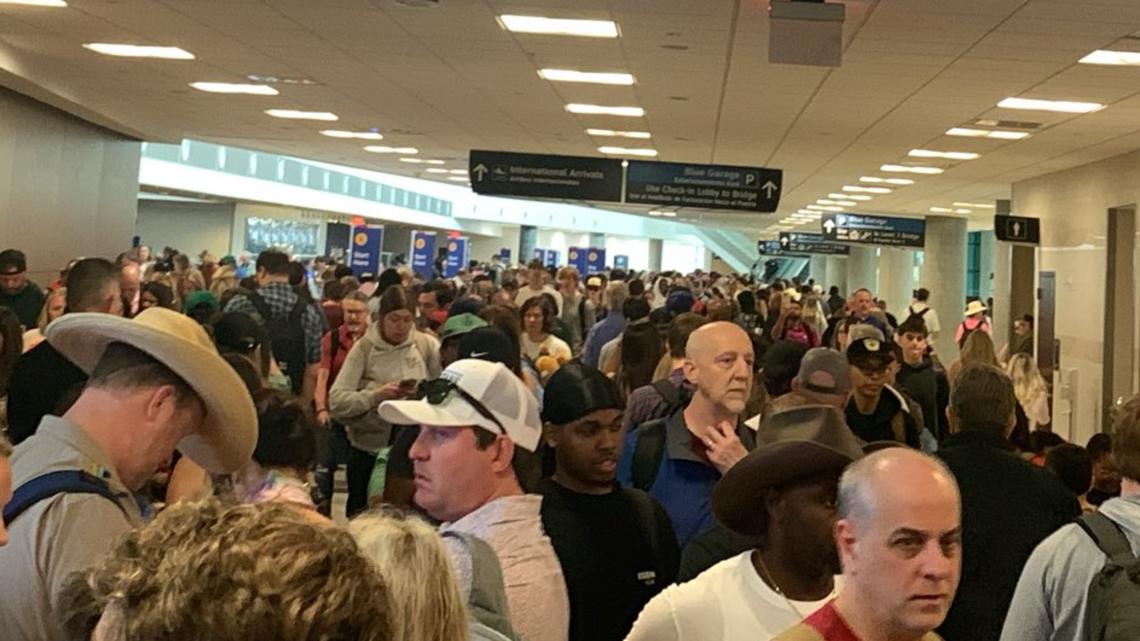
Security wait times at William P. Hobby Airport stretched 4–5 hours on Sunday as TSA staffing shortages tied to a partial DHS funding lapse reduced screening lanes; some travelers waited ~3 hours and at least one missed a flight. Houston Airport System expects more than 2.2 million passengers through Hobby and Bush during spring break and recommends arriving 4–5 hours early; this is an operational/localized disruption with minimal broader market impact.
Airlines and airports have asymmetric exposure to short, concentrated shocks at security checkpoints because throughput scales nonlinearly with open lanes: removing 1–2 lanes at a small airport can cut effective throughput by 10–25% versus 2–5% at a large hub, producing outsized missed-connection and re-accommodation costs in the near term. That mechanical leverage favors carriers operating out of larger, more redundant hubs that can absorb diverted passengers with minimal schedule disruption, while single-carrier-dominant airports see a magnified reputational hit that can depress load factors for weeks.
Rebooking and disruption costs cascade into measured P&L: assume $150–$300 incremental cost per disrupted passenger (rebooked ticket, hotels, crew swaps) and a 1–3% short-term reduction in repeat bookings for the carrier most associated with the disruption; for a mid‑sized airline this is a multi-week revenue shock that can shave 50–150 bps off quarterly margins if the disruption persists. Ancillary businesses tied to hub footfall (parking, retail concessions, regional feeders) will see divergent flows — larger hubs pick up spend while small-hub concessions lose high‑margin impulse sales.
Tail risks and reversals are driven less by consumer sentiment than by policy/timing and operational fixes: quick reversals happen within days if capacity is restored or private screening is authorized; persistent underfunding or slow contractor onboarding pushes impacts into months and forces schedule changes. Watch two high‑probability catalysts in the next 1–8 weeks — any temporary capacity relief (overtime/contractors) and airlines proactively closing risky schedules — either will materially change forward earnings trajectories and relative share performance.
AI-powered research, real-time alerts, and portfolio analytics for institutional investors.
Request DemoOverall Sentiment
mildly negative
Sentiment Score
-0.25
