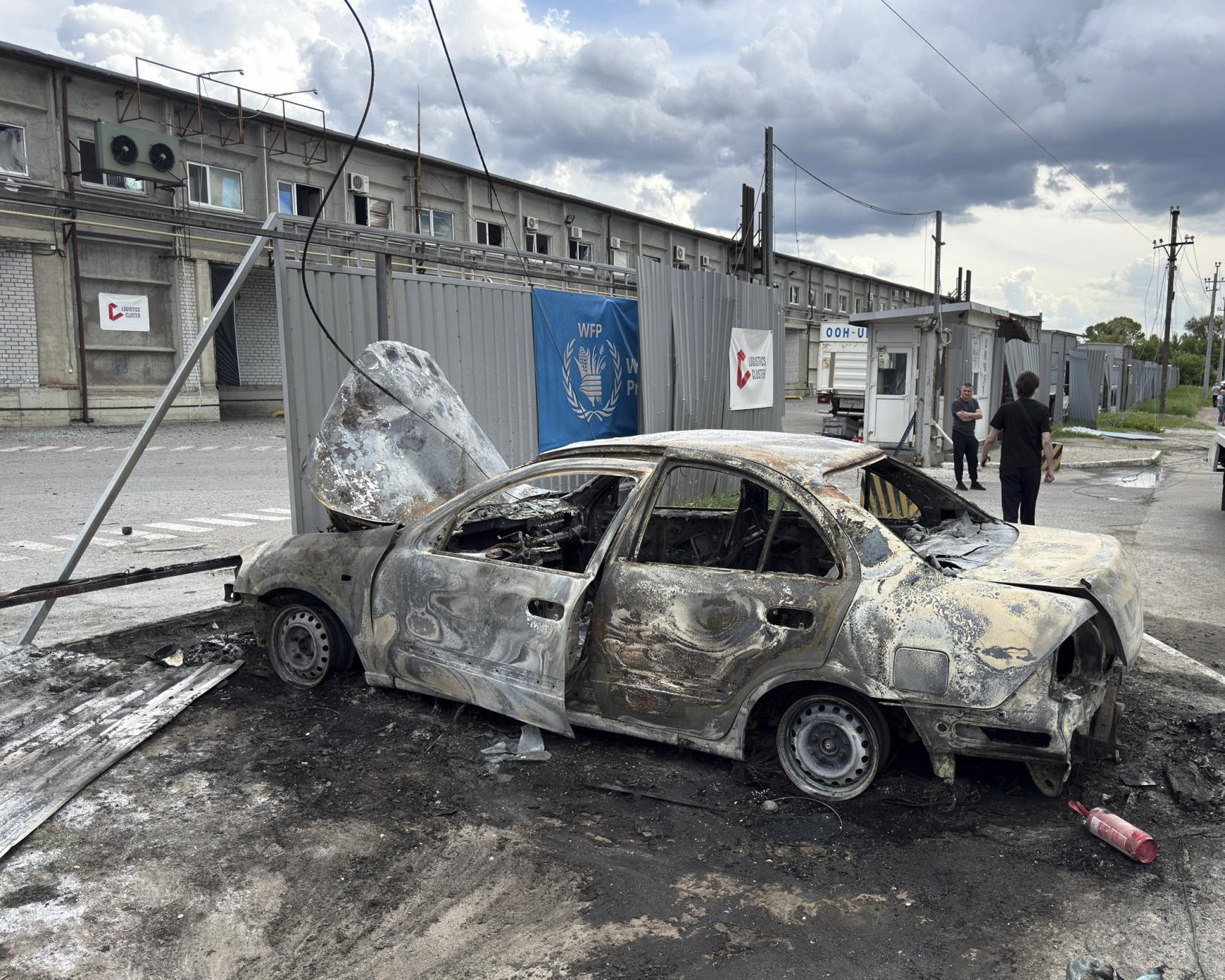
A Russian Iskander missile strike damaged a U.N. World Food Programme warehouse in Dnipro on May 25, destroying food aid worth about $1.4 million and enough to feed 130,000 people. No WFP staff were injured, but the warehouse was hit for a second time and follows another Dnipro strike on May 20 that destroyed more than $1 million of UNHCR aid. The attacks underscore escalating risk to humanitarian logistics in central-eastern Ukraine and broader wartime disruption to aid flows.
The immediate market impact is not on commodity prices but on the reliability premium embedded in any asset tied to Ukraine’s logistics corridor. Repeated strikes on aid warehousing raise the probability that donors, insurers, and transport providers demand more expensive routing, higher security spend, and larger inventory buffers, which quietly increases the cost of moving everything from food to industrial inputs through the region. That is a second-order negative for local operators and a subtle positive for alternative corridors in Poland, Romania, and Slovakia that can absorb rerouted flows.
The more important signal is escalation against clearly civilian infrastructure with a humanitarian purpose, which increases tail risk around cross-border spillovers and reduces the odds of a clean near-term de-escalation narrative. In the next 1-4 weeks, the main catalyst is not another headline strike but the response from donors and multilateral agencies: if warehousing is repeatedly compromised, aid agencies may shift to smaller, more dispersed storage nodes, which raises per-unit logistics costs and lowers throughput efficiency. Over 3-6 months, that can translate into tighter local supply, higher regional inflation, and slower reconstruction execution.
Contrarian angle: the market may be overfocusing on the headline shock and underpricing the operational adaptation. If this forces a move away from large static depots toward distributed storage and escort-heavy convoys, some logistics and security providers can actually see higher utilization, while standardized warehouse REIT-style exposure to the region becomes structurally less attractive. The key is that this is less a one-off destruction event than a marginal-cost increase regime for every humanitarian shipment entering eastern Ukraine.
AI-powered research, real-time alerts, and portfolio analytics for institutional investors.
Request DemoOverall Sentiment
strongly negative
Sentiment Score
-0.75
