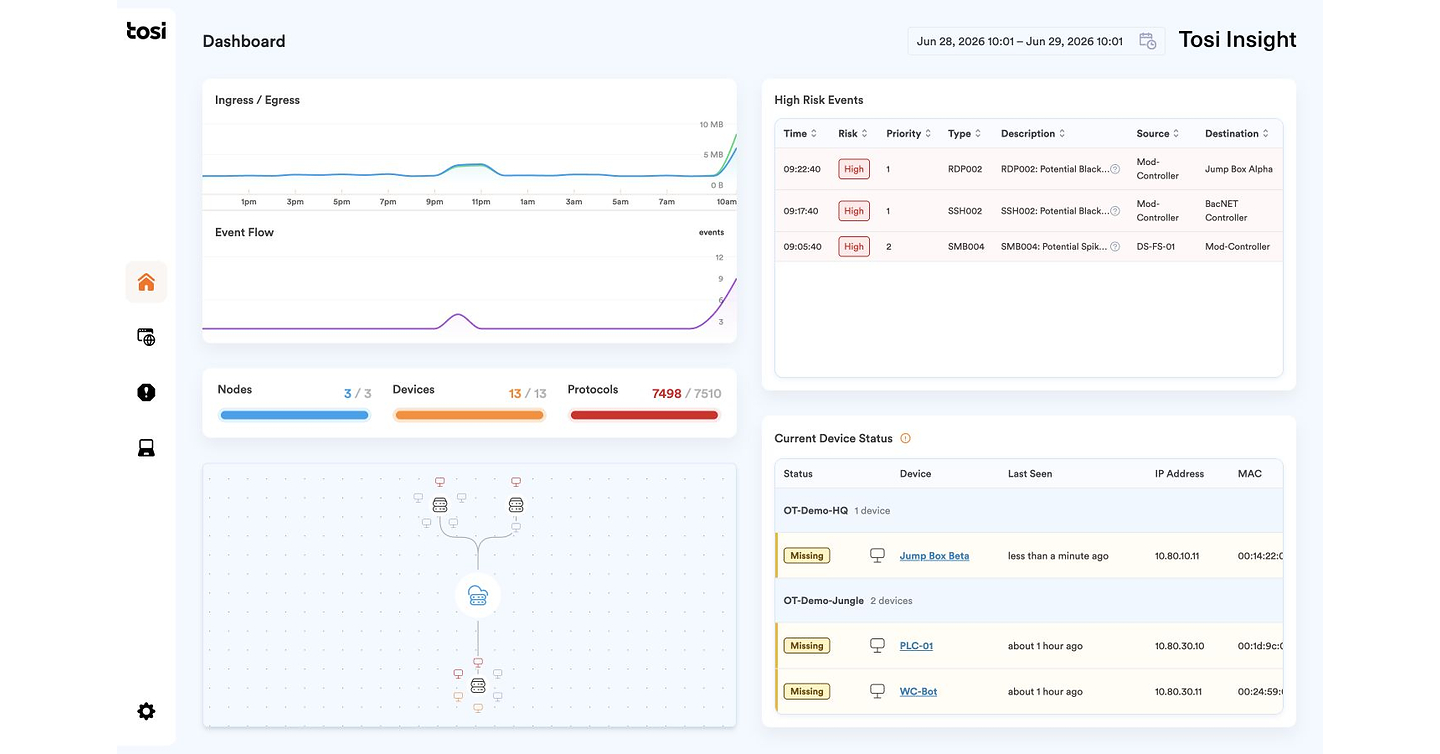
Tosi launched Tosi Insight, an OT operational intelligence layer that analyzes OT network traffic to identify assets, detect unusual activity, and prioritize operational risks beyond traditional infrastructure monitoring. The product extends Tosi Control (cloud console launched in January 2026) and follows an early-access program where customers identified undocumented assets and reduced manual investigation effort. Tosi Insight is available now for U.S. customers and will expand worldwide over the coming weeks, with continuous monitoring, anomaly detection, traffic analytics, and context-rich investigations as core capabilities.
This is less a single-company product launch than evidence that OT security is converging into a platform stack: access/control, asset inventory, and behavioral visibility are being packaged together, which usually expands wallet share at the expense of point tools and manual services. The immediate beneficiaries are vendors that can sell into industrial networks with a unified console — think PANW, FTNT, and to a lesser extent CRWD — because the budget line is shifting from niche “security add-on” to uptime and operations software. The losers are narrow OT asset-discovery and monitoring specialists that cannot prove lower false-positive rates or faster remediation, as buyers will prefer fewer consoles and one throat to choke.
The important second-order effect is not breach prevention but downtime avoidance. OT buyers typically justify spend through reliability, maintenance efficiency, and remote-operations labor savings, so the adoption curve should be faster in asset-intensive sectors with distributed sites: utilities, manufacturing, and energy. That makes the near-term catalyst a channel check story over the next 1-3 quarters: if the product is actually pulling through broader deployments, watch for commentary on attach rates, gross margin lift from software mix, and lower services intensity; if not, this stays a feature addition with little market impact.
Contrarian view: the market may overrate how much incremental revenue a visibility layer creates. In OT, many “undocumented asset” discoveries simply surface hygiene problems that customers fix once, then budget freezes; the result is often better retention, not a step-function expansion. The thesis breaks if adoption stalls after pilots, if customers keep the tool isolated from incident response workflows, or if large industrials continue to buy best-of-breed point solutions instead of platforms.
AI-powered research, real-time alerts, and portfolio analytics for institutional investors.
Request TrialOverall Sentiment
mildly positive
Sentiment Score
0.18
