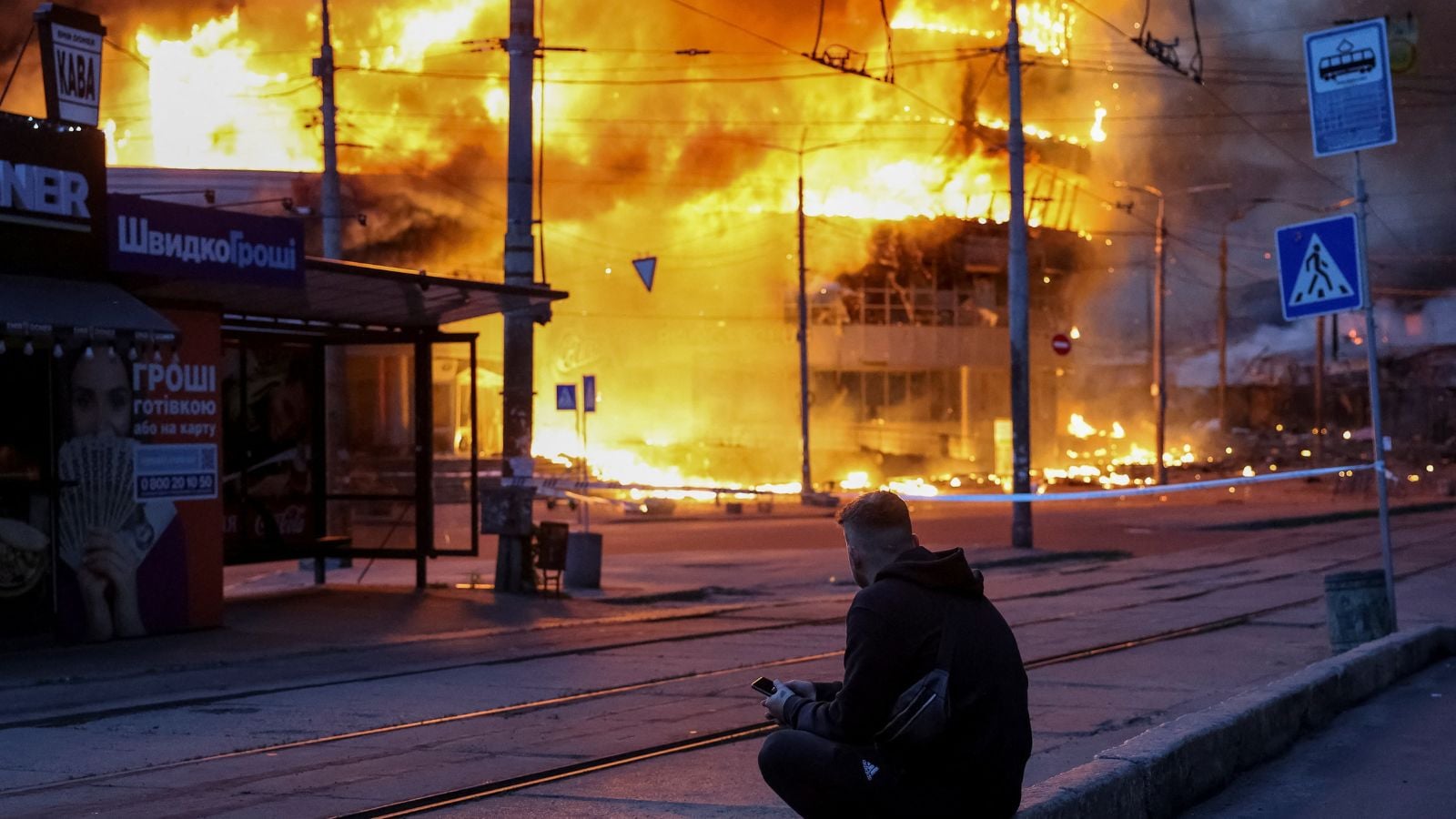
Russia used the hypersonic Oreshnik ballistic missile in a strike on Kyiv, killing at least 2 people and injuring at least 83, while causing extensive damage to residential buildings, schools, and government offices. The article highlights the missile's Mach 10 speed, 3,000-5,500 km range, and potential nuclear capability, underscoring a significant escalation in the Russia-Ukraine conflict. The event raises geopolitical risk and could support defense-sector attention and broader risk-off sentiment.
The market implication is less about the weapon itself than the signaling shift: Russia is advertising that it can escalate from attritional war to selective strategic intimidation without crossing the formal nuclear threshold. That raises the probability of higher defense budgets, faster interceptor procurement, and more pressure on NATO governments to pre-fund replenishment rather than wait for parliamentary cycles, which is constructive for prime contractors but even more so for missile defense, sensors, electronic warfare, and drone countermeasure suppliers with backlog visibility.
The second-order loser is not only Ukraine-linked reconstruction risk; it is the broader European growth complex. Every escalation event like this increases tail hedging demand, widens energy/shipping risk premia in the Black Sea basin, and delays capex decisions in industrials with Eastern Europe exposure. Over the next days to weeks, the most vulnerable assets are small-cap European cyclicals and transport names that price a normalization in war risk; over months, the bigger issue is sustained margin pressure from higher security, insurance, and logistics costs.
The contrarian point is that headline intensity may be approaching saturation while actual military utility is limited. If the attack is primarily coercive rather than preparatory to a broader campaign, markets may fade the initial risk-off move once there is no follow-through on critical infrastructure, cross-border spillover, or NATO response. The better trade is to own the suppliers of persistent escalation rather than the broad defense basket: systems that get replenished after every strike tend to outperform the names exposed to one-time sentiment spikes.
A true tail risk is miscalculation around interception or attribution. If a future strike causes mass civilian casualties, hits government leadership nodes, or lands near NATO territory, you get a discontinuous repricing in European equities and energy, not just defense. The time horizon for that tail is days to months, but the structural allocation shift to defense and resilience spending can persist for years.
AI-powered research, real-time alerts, and portfolio analytics for institutional investors.
Request DemoOverall Sentiment
strongly negative
Sentiment Score
-0.85
